


Personalized Autonomy Allocation (Apa)
Verified 01 June 2026 - Public Service / Directorate of Legal and Administrative Information (Prime Minister)
You can, under conditions of age, residence and loss of autonomy, obtain theApa: titleContent. The Apa is used to pay (in whole or in part) either the expenses necessary to stay at your home (Apa at home), i.e. the dependency rate of the medico-social establishment (example: Ehpad: titleContent) where you live (Apa in institution). We present you the information to know.
The rules are different, depending on whether you are applying for an Apa at home or an Apa in an institution:
At home
The Apa is used to pay (in whole or in part) the expenses necessary to allow you to stay at home.
It is paid by the services of the department.
Video: What is Apa?
Vidéo - CNSA - Apa
Lucien feels difficulties in his daily tasks. He/she applies for an APA (personalized autonomy allowance). A professional from the departmental council comes to assess his needs and his situation at home.
You must meet 4 conditions:
1. Age
You must be at least 60 years old.
2. Loss of autonomy
You must be in a situation of loss of autonomy (need for help to perform the acts of everyday life, or state of health requiring constant monitoring).
The loss of autonomy is measured using the grid Act: titleContent. This grid defines several degrees of loss of autonomy, ranging from Gir 1 (strongest loss of autonomy) to Gir 6 (weakest loss of autonomy).
Only the person classified as Gir 1, Gir 2, Gir 3 or Gir 4 can get the Apa.
3. Residence in France
You must reside in France on a stable and regular basis:
- Either at your home
- Either at the home of a close to who you are staying
- Either at a welcoming family
- Either in an independent residence (formerly called home-dwelling)
If you are a foreigner, you must have a residence card or residence permit.
4. Benefits not cumulative with the Apa
It is not possible to receive the AAA when you receive at least one of the following benefits:
- Simple Allocation social assistance for the elderly
- Aid from pension funds
- Financial assistance to pay a home help
- Disability Compensation Benefit (DCP)
- Increase for constant help from a third party
- Third-Party Supplementary Benefit (TPIP). But the person who receives the PSSRB may file an Apa application filein order to then be able to choose, between these two aids, the one which suits him best.
Depending on your department, you can apply online or with a form.
To find out, enter your department number or postal code:
How to apply for home independence assistance depending on your department of residence?
FYI
If you have changed departments for less than 3 months, or if you live in an independent residence, or if you live with a family caregiver, you must apply to your former place of residence.
Répondez aux questions successives et les réponses s’afficheront automatiquement
Online
If your department allows online application, you must use the online service below:
Online application for home independence aids for the elderly
With a form
If your department allows you to apply with a form, you must use cerfa n°16301:
Application for home independence assistance for the elderly
You must provide the following supporting documents:
- Photocopy of your ID card (front and back), passport or family booklet, or, if you are a foreigner outside EU, EEA and Switzerland, photocopy of your valid residence card or residence permit
- Photocopy of your last income tax or non-income tax notice
- Bank Identity Statement (Rib)
- Photocopy of your last property tax notice (in some cases)
Please note
Apa's application file also allows for a simplified application to mobility card inclusion (CMI).
The services of the department have 10 days to acknowledge receipt of your file. If your file is incomplete, the department will ask you for the missing documents.
If your situation is of a medical or social emergency (change in the state of health, social environment...), the flat-rate Apa can be assigned to you urgently and temporarily. She's from €1,040.16.
To find out what you need to do, contact the department's services.
There are several steps:
Assessment of loss of autonomy
When your complete file, a professional from the medical-social team (EMS) of your department travels to your home.
During this visit, this professional determines your degree of loss of autonomy based on the grid Act: titleContent. This grid defines several degrees of loss of autonomy, ranging from Gir 1 (strongest loss of autonomy) to Gir 6 (weakest loss of autonomy).
The professional also assesses your situation and needs. If necessary, it also assesses the situation and needs of your caregiver.
Proposal for aid
The response to your request depends on your degree of loss of autonomy, as assessed by the medical-social team (MSS) professional.
Reminder
The loss of autonomy is evaluated on the basis of the grid Act: titleContent. This grid defines several degrees of loss of autonomy, ranging from Gir 1 (strongest loss of autonomy) to Gir 6 (weakest loss of autonomy).
Répondez aux questions successives et les réponses s’afficheront automatiquement
If you are classified as Gir 1, Gir 2, Gir 3 or Gir 4
The EMS professional offers you a support plan.
This assistance plan may provide, for example, for the following benefits:
- Remuneration for a home help or a welcoming family
- Aid for transport, delivery of meals
- Technical aids and housing adaptation measures
- Temporary reception (in institution or host family)
The amount of the APA you will receive may cover all or part of the aid provided for in the aid plan.
The EMS professional may also recommend other measures of assistance (for the purpose of prevention or support to your patients). caregivers) not supported by the Apa.
You have 10 days to accept the proposed assistance plan or to request changes.
It is the department that decides on the allocation of the Apa. The department's decision is yours notified after your acceptance of the aid plan.
Please note
The decision of the department must be taken within 2 months which follow the date of receipt of your (complete) application file.
If you are classified as Gir 5 or Gir 6
You can't get the Apa at home.
But you can ask for help from your pension fund.
What is the maximum monthly amount of Home Apa?
The Home Apa cannot exceed a maximum monthly amount, which depends on your Gir: titleContent :
Gir | Amount |
|---|---|
Gir 1 | Maximum €2,080.33 per month |
Gir 2 | Maximum €1,682.30 per month |
Gir 3 | Maximum €1,215.99 per month |
Gir 4 | Maximum €811.52 per month |
FYI
If the Home Apa is less than €36.93, it shall not be paid.
What is the Home Apa Top-Up for Caregiver Essential?
Surcharge for respite devices for the caregiver
The maximum monthly amount may be increased if the caregiver needs a break.
For this, the caregiver must be indispensable. This is the case when the following two conditions are met:
- You would be in danger without the caregiver's supervision
- No other person (except a professional) can replace the caregiver
This increase is used to finance respite measures (day care, temporary accommodation...).)
The maximum amount of the increase shall be fixed for one year at €583.52.
This amount must be used within one year of its allocation.
Increase in the case of hospitalization of the caregiver
The maximum monthly amount can be increased occasionally in case of hospitalization of the patient. caregiver .
For this, the caregiver must be indispensable. This is the case when the following two conditions are met:
- You would be in danger without the caregiver's supervision
- No other person (except a professional) can replace the caregiver
This increase is used to finance relay solutions (home help, temporary reception...).)
The maximum amount of the surcharge is €1,159.32 by hospitalization.
This amount must be used during the relevant hospital stay.
What is the financial contribution of the Apa at Home recipient?
The Home Apa is equal to the amount of the portion of the assistance plan you use, less any amount remaining at your expense (also known as your financial contribution).
This sum is determined by the amount of your resources and the amount of your aid plan.
It varies, depending on whether you live alone or as a couple:
Répondez aux questions successives et les réponses s’afficheront automatiquement
You're alone
To estimate the amount of your monthly out-of-pocket expenses, you need to know the following 2 amounts:
- The amount of your aid plan
- The total amount of your resources per month. But only some of your resources are taken into account. These resources are listed in the "Monthly assessed resources" column of the following table.
Resources considered (assessed monthly) | Excluded Resources |
|---|---|
|
|
Your share of the remainder is set according to the following table:
Total resources per month | Share of remaining expenses per month |
|---|---|
Up to €933.89 | None |
Greater than €933.89 and until €3,439.31 | The remaining costs vary gradually from 0 % to 90 % of the amount of the accepted aid plan |
Greater than €3,439.31 | The remaining costs shall be equal to 90 % of the amount of the accepted aid plan |
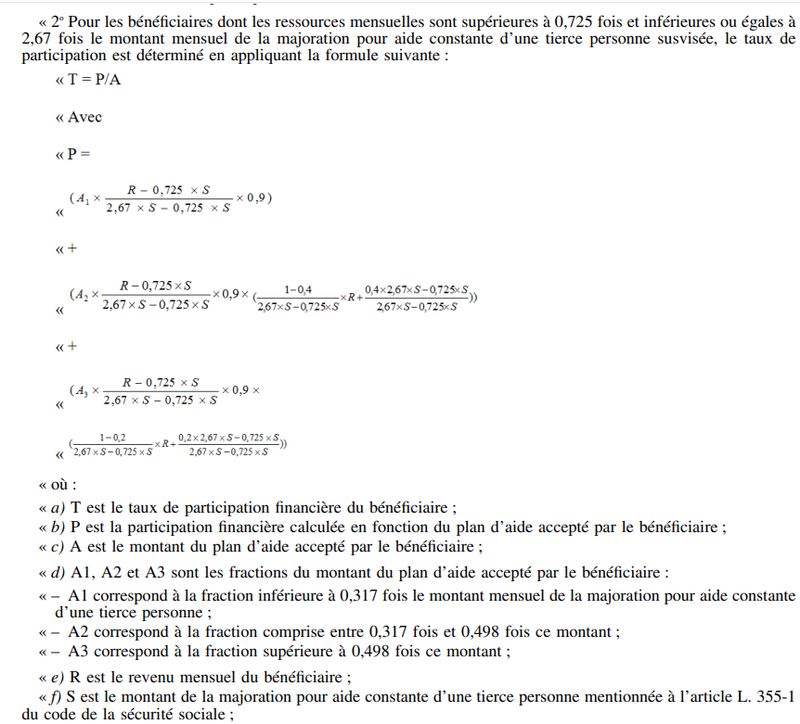
Decree n°2016-2010 of 26 February 2016 on the upgrading and improvement of the Apa
You're married, past, common-law
To estimate the amount of your monthly out-of-pocket expenses, you need to know the following 2 amounts:
- The amount of your aid plan
- The total amount of your couple's resources per month. But only some of your couple's resources are taken into account. These resources are listed in the "Monthly assessed resources" column of the following table. The total amount of your couple's resources per month is the total amount of these resources, measured per month, divided by 1.7.
Example :
The total of the column « Resources considered (monthly) » is €3,400.
The total amount of your couple's resources per month is obtained by dividing €3,400 by 1.7.
The total amount of your couple's resources per month is therefore of €2,000.
Resources considered (assessed monthly) | Excluded Resources |
|---|---|
|
|
Your share of the remainder is set according to the following table:
Total resources per month | Share of remaining expenses per month |
|---|---|
Up to €933.89 | None |
Greater than €933.89 and until €3,439.31 | The remaining costs vary gradually from 0 % to 90 % of the amount of the accepted aid plan |
Greater than €3,439.31 | The remaining costs shall be equal to 90 % of the amount of the accepted aid plan |
Decree n°2016-2010 of 26 February 2016 on the upgrading and improvement of the Apa
The Apa is paid to you as follows:
- The part used to pay regular aid is paid monthly. The 1er payment shall take place in the month following that of the award decision, including the payment of the Apa due from the date of the opening of rights.
- The part used to pay expenses relating to technical aids, accommodation adjustment and temporary reception or respite at home benefits may be subject to a one-off payment.
- The portion used to pay an employee employed at home, a foster parent or an authorized home help service may be paid in the form of Cesu pre-funded.
Exceptions are possible:
- Part of the Apa can be paid directly to the home help service you have chosen.
- A portion can be paid directly to the person or organization that provides you with technical assistance, arranges the accommodation or provides temporary reception or respite at home.
The payment of the Home Apa can be suspended in at least one of the following :
- If you do not make the declaration of your home help or host family that hosts you, within one month of the notification of allocation of the Apa. To make this declaration to the department services, you must use the form cerfa no. 10544.
- If you do not provide proof of expenses requested by the department, within one month of this request
- If you do not pay your participation
- If the medico-social team finds that the service provided is not the one prescribed, or that it presents a risk to your health, safety or physical or moral well-being
- If you are hospitalized for more than 30 days. Suspension begins on 31e day of hospitalization.
But you can challenge the suspension of the payment of the Apa at home.
You must first make an amicable appeal to then be able to make a contentious appeal.
Mandatory Prior Administrative Remedy (Rapo)
If you are challenging a decision regarding the Apa, you can make a compulsory prior administrative appeal in front of the department's services. You must do so within 2 months of the notification the decision you are challenging.
To do this, you must write a letter explaining why you do not agree with the decision related to your APA. You must attach a copy of the notification the decision, as well as any documents you consider useful.
You must either send these documents by registered mail with acknowledgement of receipt, or deposit them at the reception of the services of the department.
The president of the departmental council has 2 months to answer you, after receiving your appeal.
Litigation
You can appeal the decision rendered under the compulsory prior administrative appeal.
To do this, you must file a contentious appeal before the administrative court.
Who shall I contact
You must do so within 2 months of notification of the decision you are challenging.
If you wish, you can challenge the decision of the Administrative Court by a appeal to the Council of State.
If the amount of Apa you receive is not in fact owed to you (in whole or in part), you must repay it.
This reimbursement is made as follows:
- Either by monthly deductions from the amount of future allowances (up to 20% maximum monthly allowance)
- Either, if you can no longer receive the Apa because your situation has changed, in one or more installments
Overpayment of an amount less than or equal to €36.93 is not claimed from you.
After the death of the elderly person, the amount of the Apa that he received is not to be repaid. This amount is therefore not recoverable from the estate, nor from a legatee, of a donee, or a beneficiary of life insurance contract.
Within one month of the notification of the award decision, you must fill in the cerfa form n°10544, indicating the employee(s) hired or the home help service you use.
Declaration of a personalized autonomy allowance
This form must then be sent to the department's services.
Warning
If your situation changes (relocation, hospitalization, change of family or employee situation, change in your income...), you must report this change to the department.
You can request a reassessment of your needs (revision of your assistance plan and accordingly of the amount of your Apa), in case of modification:
- Either your personal or financial situation
- Either the personal situation of your caregiver.
This request may be made:
- Either by yourself
- Either by your legal representative
- Either by a caregiver
After receiving your complete application file, your application can be considered, either urgently or within 2 months, depending on the circumstances.
To find out how to apply, you must contact the following organization:
General case
In Paris
Who shall I contact
If the revision leads to a reduction in the amount of the Apa, you can challenge this decision:
You must first make an amicable appeal to then be able to make a contentious appeal.
Mandatory Prior Administrative Remedy (Rapo)
If you are challenging a decision regarding the Apa, you can make a compulsory prior administrative appeal in front of the department's services. You must do so within 2 months of the notification the decision you are challenging.
To do this, you must write a letter explaining why you do not agree with the decision related to your APA. You must attach a copy of the notification the decision, as well as any documents you consider useful.
You must either send these documents by registered mail with acknowledgement of receipt, or deposit them at the reception of the services of the department.
The president of the departmental council has 2 months to answer you, after receiving your appeal.
Litigation
You can appeal the decision rendered under the compulsory prior administrative appeal.
To do this, you must file a contentious appeal before the administrative court.
Who shall I contact
You must do so within 2 months of notification of the decision you are challenging.
If you wish, you can challenge the decision of the Administrative Court by a appeal to the Council of State.
You can challenge any decision regarding the Apa: denial of allocation, proposed amount, suspension of its payment or reduction of its amount.
You must first make an amicable appeal to then be able to make a contentious appeal.
Mandatory Prior Administrative Remedy (Rapo)
If you are challenging a decision regarding the Apa, you can make a compulsory prior administrative appeal in front of the department's services. You must do so within 2 months of the notification the decision you are challenging.
To do this, you must write a letter explaining why you do not agree with the decision related to your APA. You must attach a copy of the notification the decision, as well as any documents you consider useful.
You must either send these documents by registered mail with acknowledgement of receipt, or deposit them at the reception of the services of the department.
The president of the departmental council has 2 months to answer you, after receiving your appeal.
Litigation
You can appeal the decision rendered under the compulsory prior administrative appeal.
To do this, you must file a contentious appeal before the administrative court.
Who shall I contact
You must do so within 2 months of notification of the decision you are challenging.
If you wish, you can challenge the decision of the Administrative Court by a appeal to the Council of State.
In institution
If you are staying in a medical-social facility (for example, a Ehpad: titleContent or USLD: titleContent), theApa: titleContent covers part of the dependency rate set by the establishment.
You must meet 4 conditions:
1. Age
You must be at least 60 years old.
2. Loss of autonomy
You must be in a situation of loss of autonomy (need for help to perform the acts of everyday life, or state of health requiring constant monitoring).
The loss of autonomy is measured using the grid Act: titleContent. This grid defines several degrees of loss of autonomy, ranging from Gir 1 (strongest loss of autonomy) to Gir 6 (weakest loss of autonomy).
Only the person classified as Gir 1, Gir 2, Gir 3 or Gir 4 can get the Apa.
3. Residence in France
Your host institution must be located in France and accommodate at least 25 dependent elderly people. If this property has less, you must ask the Apa at home.
4. Non-cumulative income with ABS
It is not possible to receive the AAA when you receive at least one of the following benefits:
- Simple Allocation social assistance for the elderly
- Aid from pension funds
- Financial assistance to pay a home help
- Disability Compensation Benefit (DCP)
- Increase for constant help from a third party
- Third-Party Supplementary Benefit (TPIP). But the person who receives the PSSRB may file an Apa application filein order to then be able to choose, between these two aids, the one which suits him best.
After choosing the establishment where you will reside (Ehpad: titleContent or USLD: titleContent), you must inquire with the management of this institution to know the procedure to be done.
Please note
The staff at the property can help you apply for an Apa in an institution.
If your situation is urgent medical or social (change in the state of health, social environment...), the flat-rate Apa can be assigned to you urgently and temporarily.
To find out what you need to do, ask your department:
Your request is then considered. This is to assess your degree of loss of autonomy. This evaluation is done by the host institution.
If, at the end of the assessment, you are classified in one of groups 1 to 4 of the grid Act: titleContent, you can get the Apa in institution.
The Apa is then due to you from the date of submission of your complete application file.
FYI
The award decision is made by the department's departments. The department's services must make their decision within 2 months of the date of receipt of your complete application file.
The Apa is used to pay the dependency rate that the host institution charges you.
But, according to your resources, the Apa may not cover the entire dependency rate.
In this case, a financial contribution remain at your expense.
FYI
In addition to dependency rate, theEhpad: titleContent invoice one accommodation rate. Assistance may be provided to help you pay the accommodation rate, including housing assistance (APL or ALS) and a social assistance in accommodation (ASH)).
The amount of your financial contribution varies, depending on whether you live alone or as a couple:
Répondez aux questions successives et les réponses s’afficheront automatiquement
You're alone
Estimate your remaining charge on the dependency rate of the Ehpad
THEEhpad: titleContent who is hosting you will charge you a dependency rate.
The Apa is used to pay part of this fee. The other part is left to you.
The part that is left to your charge depends on the following 2 amounts:
- The dependency rate charged by the Ehpad. To find out, ask the Ehpad.
- The total amount of your resources per month. But only some of your resources are taken into account. These resources are listed in the "Monthly assessed resources" column of the following table.
Resources considered (assessed monthly) | Excluded Resources |
|---|---|
|
|
Your share of the remainder is set according to the following table:
Total resources per month | Dependency Price List Amount remaining unpaid |
|---|---|
Up to €2,846.77 | Dependency rate of the Gir 5 and GIR 6 of theEhpad: titleContent |
Greater than €2,846.77 and until €4,379.64 | Dependency rate of the Gir 5 and Gir 6 of the Ehpad, to which is added an amount that varies from 0% to 80% of the difference between the dependency rate of your Gir and the dependency rate of the Gir 5 and Gir 6 |
Greater than €4,379.64 | Dependency rate of Gir 5 and Gir 6, plus 80% of the difference between the dependency rate of your Gir and the dependency rate of Gir 5 and Gir 6 |
Estimate your remaining charge on all rates of the Ehpad
In addition to dependency rate, theEhpad: titleContent invoice one accommodation rate.
Assistance may be provided to help you pay the accommodation rate, including housing assistance (APL or ALS) and a social assistance in accommodation (ASH)).
To find out the rest of the cost, after deduction of the Apa and the housing assistance, you can use this simulator:
Éhpad directory, Éhpad price comparison and services, Éhpad defrayal comparison
You're married, past, common-law
Estimate your remaining charge on the dependency rate of the Ehpad
THEEhpad: titleContent who is hosting you will charge you a dependency rate.
The Apa is used to pay part of this fee. The other part is left to you.
The part that is left to your charge depends on the following 2 amounts:
- The dependency rate charged by the Ehpad. To find out, ask the Ehpad.
- The total amount of your resources per month. But only some of your resources are taken into account. These resources are listed in the "Monthly assessed resources" column of the following table. The total amount of your couple's resources per month is the total amount of these resources, measured per month, divided by 2.
Example :
The total of the column « Resources considered (monthly) » is €3,400.
The total amount of your couple's resources per month is obtained by dividing €3,400 by 2.
The total amount of your couple's resources per month is therefore of €1,700.
Resources considered (assessed monthly) | Excluded Resources |
|---|---|
|
|
Your share of the remainder is set according to the following table:
Total resources per month | Dependency Price List Amount remaining unpaid |
|---|---|
Up to €2,846.77 | Dependency rate of the Gir 5 and GIR 6 of theEhpad: titleContent |
Greater than €2,846.77 and until €4,379.64 | Dependency rate of the Gir 5 and Gir 6 of the Ehpad, to which is added an amount that varies from 0% to 80% of the difference between the dependency rate of your Gir and the dependency rate of the Gir 5 and Gir 6 |
Greater than €4,379.64 | Dependency rate of Gir 5 and Gir 6, plus 80% of the difference between the dependency rate of your Gir and the dependency rate of Gir 5 and Gir 6 |
Estimate the remaining charge on all rates of the Ehpad
In addition to dependency rate, theEhpad: titleContent invoice one accommodation rate.
Assistance may be provided to help you pay the accommodation rate, including housing assistance (APL or ALS) and a social assistance in accommodation (ASH)).
To find out the rest of the cost, after deduction of the Apa and the housing assistance, you can use this simulator:
Éhpad directory, Éhpad price comparison and services, Éhpad defrayal comparison
Conditions for payment
The 1er payment shall take place in the month following that of the award decision.
The allowance is paid to you each month, no later than the 10th of the month to which it relates.
The Apa is paid directly to the property or, if you request it, to your bank account.
Emergency Allocation
In the event of an attested medical or social emergency, you may receive the Apa on a temporary basis, for a maximum of 2 months from the date of submission of the application.
In this case, you receive an advance equal to half of the dependency rate that your host institution charges a resident classified in Gir 1 or Gir 2 of the grid Act: titleContent. This advance will be withdrawn from the Apa amounts that will be paid to you later.
If the amount of Apa you receive is not in fact owed to you (in whole or in part), you must repay it.
This reimbursement is made as follows:
- Either by monthly deductions from the amount of future allowances (up to 20% maximum monthly allowance)
- Either, if you can no longer receive the Apa because your situation has changed, in one or more installments
Overpayment of an amount less than or equal to €36.93 is not claimed from you.
After the death of the elderly person, the amount of the Apa that he received is not to be repaid. This amount is therefore not recoverable from the estate, nor from a legatee, of a donee, or a beneficiary of life insurance contract.
You can request a reassessment of your needs (revision of your assistance plan and accordingly of the amount of your Apa), in case of modification:
- Either your personal or financial situation
- Either the personal situation of your caregiver.
This request may be made:
- Either by yourself
- Either by your legal representative
- Either by a caregiver
After receiving your complete application file, your application can be considered, either urgently or within 2 months, depending on the circumstances.
To find out how to apply, you must contact the following organization:
General case
In Paris
Who shall I contact
If the revision leads to a reduction in the amount of the Apa, you can challenge this decision:
You must first make an amicable appeal to then be able to make a contentious appeal.
Mandatory Prior Administrative Remedy (Rapo)
If you are challenging a decision regarding the Apa, you can make a compulsory prior administrative appeal in front of the department's services. You must do so within 2 months of the notification the decision you are challenging.
To do this, you must write a letter explaining why you do not agree with the decision related to your APA. You must attach a copy of the notification the decision, as well as any documents you consider useful.
You must either send these documents by registered mail with acknowledgement of receipt, or deposit them at the reception of the services of the department.
The president of the departmental council has 2 months to answer you, after receiving your appeal.
Litigation
You can appeal the decision rendered under the compulsory prior administrative appeal.
To do this, you must file a contentious appeal before the administrative court.
Who shall I contact
You must do so within 2 months of notification of the decision you are challenging.
If you wish, you can challenge the decision of the Administrative Court by a appeal to the Council of State.
You can challenge any decision regarding the Apa: denial of allocation, proposed amount, suspension of its payment or reduction of its amount.
You must first make an amicable appeal to then be able to make a contentious appeal.
Mandatory Prior Administrative Remedy (Rapo)
If you are challenging a decision regarding the Apa, you can make a compulsory prior administrative appeal in front of the department's services. You must do so within 2 months of the notification the decision you are challenging.
To do this, you must write a letter explaining why you do not agree with the decision related to your APA. You must attach a copy of the notification the decision, as well as any documents you consider useful.
You must either send these documents by registered mail with acknowledgement of receipt, or deposit them at the reception of the services of the department.
The president of the departmental council has 2 months to answer you, after receiving your appeal.
Litigation
You can appeal the decision rendered under the compulsory prior administrative appeal.
To do this, you must file a contentious appeal before the administrative court.
Who shall I contact
You must do so within 2 months of notification of the decision you are challenging.
If you wish, you can challenge the decision of the Administrative Court by a appeal to the Council of State.
Who can help me?
Find who can answer your questions in your region
General principles
Resources considered
Instruction of the application (Apa at home)
Investigation procedure and conditions for payment
Help plan surcharge (Apa at home)
Apa at home: maximum amount and financial contribution
Apa in institution: financial participation
Periodic review (Article L232-14), amicable appeal (Article L232-20), non-recovery on succession (L232-19)
Suspension Apa at home (L232-22), income not accumulated with Apa (L232-23)
Revision on request (R232-28)
Application Form Template and List of Supporting Documents (Home and Institutional Apa)
Litigation: Article L134-2 paragraph 1
Online service
FAQ
Service Public
Service Public
National Solidarity Fund for Autonomy (CNSA)
National Solidarity Fund for Autonomy (CNSA)
National Solidarity Fund for Autonomy (CNSA)
National Solidarity Fund for Autonomy (CNSA)
National Solidarity Fund for Autonomy (CNSA)
National Solidarity Fund for Autonomy (CNSA)
National Solidarity Fund for Autonomy (CNSA)
National Solidarity Fund for Autonomy (CNSA)
National Solidarity Fund for Autonomy (CNSA)
National Solidarity Fund for Autonomy (CNSA)
National Solidarity Fund for Autonomy (CNSA)
National Solidarity Fund for Autonomy (CNSA)
National Solidarity Fund for Autonomy (CNSA)