


Apprenticeship contract
Verified 01 June 2026 - Public Service / Directorate of Legal and Administrative Information (Prime Minister), Ministry of Labor
The apprenticeship contract is an employment contract which allows periods of training in company and in an apprenticeship training center to be followed alternately. How does this contract work? We present you the information to remember.
Please note
Cross-border learning is not covered in this fact sheet.
Minimum age
The apprentice must be elderly at minimum from 16 years.
But it exists 2 exemptions at this minimum age:
- Young at least 15 years of age proof of having completed the schooling of 1er secondary education (3e)
- Young person reaching the age of 15 between the start of the school year and the end of the yearcalendar year if it fills the whole the following conditions:
- Have completed the schooling of 1er secondary education (3e)
- Be enrolled in a vocational high school or in a CFA: titleContent, by having an educational status, in order to begin training leading to the issue of a diploma or a professional title, registered in RNCP: titleContent.
Maximum age
The apprentice must be elderly at maximum from 29 years of age (30 years minus 1 day).
The apprentice may be up to 35 years of age (36 years minus 1 day) in the following cases:
- Apprentice signing a new contract to access a higher degree level than that already obtained
- Previous contract of the apprentice broken for reasons beyond his control
- Previous contract of the apprentice broken for physical and temporary incapacity.
In these cases, it must not take more than 1 year between the 2 contracts.
Derogations from the maximum age
There's no no maximum age in the following cases
- Apprentice recognized disabled worker
- Apprentice planning to start or resume a company that involves graduation
- Apprentice registered as a top sportsman
- An apprentice who has not graduated and enters into a new contract with another employer to take the exam again.
Establishment of the contract
The apprenticeship contract is a contract written.
It shall contain particulars mandatory, in particular:
- Name and surname of employer (or company name)
- Staff of the company
- Diploma or title prepared by the apprentice
- Salary due for each year of the contract or apprenticeship period
- Surname, first name and date of birth of the teacher
- Certificate from the employer stating that the apprenticeship supervisor meets the professional competence requirements
- Conditions for the deduction of benefits in kind.
It shall be concluded using the form cerfa no. 10103.
The contract is signed by the employer and the apprentice (and by sound legal representative, if the apprentice is a minor).
One copy is given to the apprentice, the other is kept by the employer.
If the employer is a ascending of the minor apprentice, a declaration may replace the contract. This declaration is a simple document prepared by the employer. It specifies the commitments of the parties (duration of the contract, salary...).) It is the equivalent of the apprenticeship contract. It must be signed by the apprentice and the director of the CFA: titleContent .
Deposit of contract
The employer shall transmit to the skills operator (OPCO), at the latest within 5 working days following the start of the contract, the following documents:
- Apprenticeship contract (or declaration)
- Training agreement (title, objectives, duration, place and cost of training, means and modalities of monitoring and graduation)
- Tripartite agreement when the duration of the training is reduced or extended.
This transmission can be done by dematerialized means.
The competent operator has 20 days to decide on the financial assumption of the contract. No response from theOpco: titleContent within that period, the application shall be refused.
If the contract does not comply (apprentice's age, remuneration, age and competence of the apprenticeship master, certification Qualiopi of the training organization, for example), the OPCO refuses to accept financial responsibility for the contract. He explains the reasons for his refusal in a decision that he transmits to the employer, to the apprentice (his legal representative, if the apprentice is a minor) and CFA: titleContent.
The OPCO files the contract by dematerialized means with the ministry in charge of vocational training. In the event of refusal of financial support, the OPCO shall also inform it. He explained the reasons for this refusal.
The transfer of the apprenticeship contract is free of charge.
Transmission by dematerialized means to the skills operator can be done by digitized document (scan for example).
FYI
No financial compensation may be requested from the apprentice or his legal representative at the time of conclusion, deposit or termination of the apprenticeship contract.
If the contract has been concluded from 1er July 2025, the employer shall contribute to the financing of training some apprentices.
The apprenticeship contract may be of a duration limited (CDL) for a period of 6 months at least at 3 years maximum. It may also be of duration undetermined (DTA).
When it comes to a permanent contract, it begins with a learning period. This period of training is the one that the apprentice completes to obtain the qualification provided for in his contract (in principle, alternating between practical training in company and theoretical training in CFA: titleContent).
The duration of the contract or apprenticeship period shall be equal to the duration of the training cycle that the apprentice prepares to obtain his qualification. This period is fixed according to the type of profession and may vary.
It can be adapted to take into account the level of the apprentice, the skills already acquired (prolonged or shortened, for example). In this case, a tripartite agreement between the CFA, the employer and the apprentice is concluded.
The start date of the contract is the date of the theoretical training in CFA or the practical training at the employer.
FYI
The maximum duration of the contract may be extended to 4 years where the apprentice is a disabled worker or a top sportsman.
Minimum remuneration
The apprentice receives a remuneration corresponding to a percentage of the Smic: titleContent which varies according to his age and his progress in the training cycle.
Situation | 16 to 17 years | 18-20 years | 21-25 years | 26 years and older |
|---|---|---|---|---|
1re year | 27% the minimum wage, or €504.09 | 43% the minimum wage, or €802.82 | The + high salary between 53% the minimum wage, or €989.52 and 53% the conventional minimum wage corresponding to the employment held during the apprenticeship contract. | 100% of the Smic Highest salary between Smic: titleContent(€1,867.02) and the conventional minimum wage corresponding to the employment held during the apprenticeship contract. |
2e year | 39% the minimum wage, or €728.14 | 51% the minimum wage, or €952.18 | The + high salary between 61% the minimum wage, or €1,138.88 and 61% the conventional minimum wage corresponding to the employment held during the apprenticeship contract. | 100% of the Smic Highest salary between Smic: titleContent(€1,867.02) and the conventional minimum wage corresponding to the employment held during the apprenticeship contract. |
3e year | 55% the minimum wage, or €1,026.86 | 67% the minimum wage, or €1,250.90 | The + high salary between 78% the minimum wage, or€1,456.27 and 78% the conventional minimum wage corresponding to the employment held during the apprenticeship contract. | 100% of the Smic Highest salary between Smic: titleContent(€1,867.02) and the conventional minimum wage corresponding to the employment held during the apprenticeship contract. |
Please note
Young apprentices under the age of 16 receive the same remuneration as apprentices between the ages of 16 and 17.
The apprentice preparing a professional license in 1 year receives remuneration corresponding to a 2e contract year.
These amounts may be increased if collective agreement applicable in the company sets a higher minimum remuneration.
Deductions for benefits in kind (food or accommodation) provided for in the apprenticeship contract may be made up to 75% of salary.
The apprentice is entitled to coverage of its transport costs to get from home to work.
The conditions of remuneration for overtime shall be those applicable to the staff of the company concerned.
One simulator estimates the amount of remuneration:
Estimate the salary of an employee in an apprenticeship or professionalization contract
Salary increase
The percentage of remuneration provided for in the Labor Code shall be increased by 15 points if all of the following conditions are met:
- Contract concluded for a period of 1 year or less
- Preparation of a diploma or a title of the same level as that previously obtained
- The qualification sought is directly related to that resulting from the diploma or title previously obtained.
That mark-up does not apply the minimum wage provided for by a collective agreement.
Example :
A 19 year old apprentice completes a new CAP in 1 year directly related to the previous CAP which lasted 2 years. His remuneration was 51% the SMIC at the end of his last contract. He will therefore receive a remuneration of 51% + 15 points, or 66% the minimum wage.
Increases related to the transition from one age group to another shall take effect from 1er the day of the month following the apprentice's birthday.
Example :
An apprentice in 1re The apprenticeship year reaches the age of 21 in March. His pay will go up from 43% à 53% of the SMIC on 1er April.
Remuneration in case of reduction or increase of the training cycle
The training cycle can be reduced or increased to take into account the skills already acquired by the apprentice.
Répondez aux questions successives et les réponses s’afficheront automatiquement
Reducing the training cycle
The apprentice may have previously validated competencies of the certification he is preparing. Its training cycle can then be reduced to take account of the skills already acquired. His remuneration is what he would be entitled to if his contract had not been reduced.
Example :
An apprentice has a sufficient level of skills and training for his employer and the CFA to estimate that it takes him 1 year instead of 2 to obtain his diploma. His apprenticeship will be 1 year and his remuneration that of a 2e year of learning.
Increased training cycle
The apprentice may need to acquire a level of skills and training that requires an increase in his training cycle to obtain the certification he is preparing. His remuneration during the extension of his contract is that corresponding to the last year of his contract.
Example :
An apprentice has a level of skills and training such that his employer and the CFA estimate that it takes him 1 year and 6 months instead of 1 year to graduate. His apprenticeship will be 1 year and 6 months. The last 6 months of contract, his remuneration will be that of the 1re year of contract.
Remuneration in case of succession of contracts
The apprentice's remuneration may change if he has obtained the diploma or title he has prepared previously and that it signs a new contract.
The situation varies depending on whether the contract is signed with the same or a different employer:
Répondez aux questions successives et les réponses s’afficheront automatiquement
With the same employer
If the apprentice enters into a new apprenticeship contract, his remuneration shall be at least that which he received in the last year of the previous contract.
The retention applies to contractual, contractual or regulatory remuneration, depending on what was applied.
The percentages of remuneration according to age remain applicable if they are more favorable.
Example :
An apprentice completed an apprenticeship in 2 years with an employer with a collective agreement that was more favorable than the legal minimum.
This apprentice signs a new contract with this employer.
The employer must pay at least the previous contractual remuneration.
With a different employer
If the apprentice enters into a new apprenticeship contract, his remuneration shall be at least that to which he was entitled in the last year of the previous contract.
Retention relates to conventional pay, if the employer applies the same collective agreement as the previous employer, or otherwise, statutory pay.
The percentages of remuneration according to age remain applicable if they are more favorable.
Example :
An apprentice completed an apprenticeship contract in 2 years with an employer with a collective agreement that was more favorable than the legal minimum.
This apprentice signs a new contract with an employer that does not have a collective agreement.
The employer will not be required to pay all of the previous remuneration but only the statutory portion of it, determined according to the contract year and the age group.
Contributions
The amounts of the exemptions differ according to the start date of the apprenticeship contract:
Répondez aux questions successives et les réponses s’afficheront automatiquement
The apprentice began his contract on March 1, 2025
From a tax point of view, the apprentice benefits from 3 main advantages:
- Salary of apprentice exempt from employee contributions up to 50% from Smic: titleContent or (€933.51). The portion of the apprentice's gross monthly salary that exceeds this amount remains subject to contributions.
- Salary exempt from CSG and CRDS within the limit of 50% from Smic: titleContent or (€933.51). The portion of the apprentice's gross monthly salary that exceeds this amount is subject to the CSG and CRDS.
- Salary exempt from income tax within the limit of the annual amount of the minimum wage.
The apprentice started his contract no later than February 28, 2025
From a tax point of view, the apprentice benefits from 3 main advantages:
- Salary of apprentice exempt from employee contributions up to 79% from Smic: titleContent (or €1,475). The portion of remuneration above this amount remains subject to contributions.
- Salary exempt from CSG and CRDS
- Salary exempt from income tax within the limit of the annual amount of the minimum wage.
Apprenticeships are based on the principle of alternating between theoretical teaching in CFA and teaching the trade at the employer with whom the apprentice has signed his employment contract.
Registration in an Apprenticeship Training Center (CFA)
The apprentice has to go into training within 3 months which follow the start of the apprenticeship contract.
The apprentice's training in CFA must have a minimum duration corresponding to 25% the total duration of the contract. This time is shorter than that of vocational or technological high schools, because the time spent in company is training time.
One national trades map is issued to the apprentice by the CFA.
This card can give the following advantages:
- Access to restaurants and university accommodation
- Discounts for leisure and sports activities (sports, cinema, theater, etc.)
- Benefit from reduced and preferential fares granted to students in transport.
FYI
The training can be carried out entirely or partially remotely with a follow-up by the CFA. The training agreement between the apprentice and the CFA must specify the practical details.
Training in the company
The employer must provide practical training for the apprentice.
It entrusts the apprentice with tasks or positions that enable operations or work to be carried out in accordance with an annual progression.
This progression is defined between employers and the CFAs in which apprentices are registered.
Warning
In principle, the employer cannot entrust an apprentice with hazardous work for his health and safety.
Distribution of training hours
The time spent at the CFA and in company varies according to the training carried out. For example, 2 days at CFA and 3 in company, or 1 month at CFA and 1 month in company.
Reorientation of the apprentice during the training
An apprentice engaged in the preparation of a professional bac may, at the end of its 1re year, shorten his training. He can redirect himself towards the preparation of a certificate of professional competence (CAP), one certificate of agricultural professional competence (Capa) or agricultural professional certificate (BPA).
When the new diploma prepared is in the same professional field as the professional bac, the duration of the contract or apprenticeship period shall be reduced by one year.
End of training
If successful, the training shall result in the award of a diploma or a title recognized as being professional purpose.
If the examination fails, training and apprenticeship may be extended by1 year maximum.
The apprenticeship supervisor is directly responsible for the apprentice's training and guardian.
He accompanies the apprentice in his work towards obtaining the title or diploma prepared, in liaison with the CFA.
The employer must ensure that the apprenticeship supervisor receives training to enable him to carry out his duties.
The apprenticeship supervisor must ensure that the training provided to the apprentice has not evolved. It must also ensure that the acquisition of training is respected in order to obtain the diploma.
The learning master must be employee of the company, volunteer and major. It must also offer all the guarantees of morality and possess pedagogical and professional skills.
The employer or his or her collaborating spouse may act as a master of learning.
Professional competence of the apprenticeship master
The professional competence requirements for being a master of learning differ according to the title or diploma held:
Répondez aux questions successives et les réponses s’afficheront automatiquement
Graduate or titled Master of Learning
The apprenticeship master must have a diploma or professional title in the same field as that prepared by the apprentice. It must justify1 year of professional practice in relation to the qualification prepared by the apprentice.
Traineeships and periods of professionalization or apprenticeship shall not be taken into account in the calculation of the length of experience required.
A collective agreement or branch agreement may contain different provisions.
Master of learning without diploma or title
The apprenticeship master must provide evidence of 2 years of professional practice in relation to the qualification prepared by the apprentice.
Traineeships and periods of professionalization or apprenticeship shall not be taken into account in the calculation of the length of experience required.
A collective agreement or branch agreement may contain different provisions.
Number of apprentices per apprenticeship master
A company or establishment can accommodate maximum 2 apprentices and 1 repeating per learning master.
The Departmental Committee on Employment and Social Inclusion may grant derogations from this ceiling.
FYI
Several apprenticeship masters can carry out their duties within the company. In this case, a reference learning master is appointed from among the tutoring team. It coordinates and liaises with the CFA.
The rules differ depending on whether the apprentice is an adult or a minor.
Major
The apprentice's working time is the same as that of other employees. The legal working hours The number of working hours is set at 35 hours per week.
Training time in CFA is actual working time and account in the work schedule.
He can work overtime.
Minor
The legal duration of actual work is 35 hours per week.
Training time in CFA is actual working time and account in the work schedule.
The following rules apply to the minor apprentice:
- 2 consecutive days of rest per week
- Prohibition to work on Sundays, except in certain sectors of activity
- Night work forbidden between 10pm and 6am for a young person aged 16 to 18 and between 8pm and 6am for a young person under 16, except exemptions
- 35 hours of work per week
- Exceptionally, the apprentice can work 5 hours of overtime per week, after agreement of the labor inspector and the opinion of the occupational physician
- 8 hours of work per day
- Not more than 4 consecutive hours 30 minutes, which must be followed by a break of 30 consecutive minutes
- Prohibition to work a legal holiday.
FYI
Exceptions to these rules exist in the construction, public works and landscaping sectors. Where the collective organization of work so warrants, in these sectors the working time may be fixed at 40 hours per week and 10 hours per day.
Calculation of Apprentice's Paid Leave
The apprentice is entitled to paid leave legal, that is to say 5 weeks of paid leave per year. The employer has the right to decide on the period at which the apprentice can take his leave.
If the apprentice is under 21 years of age on April 30 of the previous year, the apprentice may apply for additional leave without pay, up to a limit of 30 working days per year. The age requirement shall be reviewed on 30 April of the year preceding the application.
Leave for Examination
For the preparation of his tests, the apprentice is entitled to an additional leave of 5 working days in the month preceding them. These days shall be in addition to paid leave and shall be paid.
Other Apprentice Leave
An apprentice can benefit from a maternity leave.
An apprentice can also benefit from a paternity leave.
The apprentice is entitled to the same leave as any other employee:
The apprentice has an exceptional leave of absence of 1 day to participate in the defense and citizenship day. This absence does not result in a loss of salary.
Yes, the apprenticeship contract can be carried out partly abroad. That's what we call the mobility of the apprentice abroad. This mobility abroad may not exceed 1 year. Nor must it exceed half of the total duration of the contract.
An agreement is concluded between the apprentice, the employer in France, the CFA: titleContent in France and the structure or structures of reception abroad.
This mobility can be carried out either as part of a standby of the contract, or as part of a provision of the apprentice to the reception structure abroad.
Sleep contract
During this period, the host company or training organization is solely responsible for the employee's working conditions.
These are determined by the legal and contractual provisions in force in the host country (health and safety at work, remuneration, working hours...).)
The Convention shall specify the following information:
- Start and end date of the mobility period
- Purpose of the training and nature of the duties assigned to the apprentice in relation to the certification
- Workplaces and possibly training places
- Contact details and quality of persons responsible for monitoring the progress in France, within the CFA: titleContent and in the host country and the conditions for follow-up
- Equipment and products used, as well as the occupational risk prevention commitments of host companies outside the European Union and training organizations
- Work rhythm and holidays
- Possibly, the conditions under which the costs are to be borne
- Possibly, the conditions for the assessment and validation of skills acquired abroad
- Rules applicable in the reception facility(ies) abroad, with regard to health and safety at work
- Information on the guarantees taken in respect of civil liability or equivalent risk coverage in the host country.
Please note
The agreement may be concluded without the employer of the host country. In this case, the commitments made by the latter must allow the apprentice to benefit from certain guarantees equivalent to those provided for in the standby agreement. These guarantees must appear on one or more documents signed by the employer of the host country, the apprentice and if necessary by the CFA: titleContent in France. The documents shall be annexed to the standby agreement.
Availability of the apprentice
The apprentice is made available on a temporary basis by the company established in France to a company or training organization located abroad.
The employment contract is not terminated or suspended. The employer retains its responsibility towards the apprentice (remuneration, employee social protection...).)
The Convention shall specify the following information:
- Start and end date and duration of the mobility period
- Purpose of the training and nature of the duties assigned to the apprentice in relation to the certification
- Workplaces and possibly training places
- Contact details and quality of the persons responsible for monitoring the progress in France and in the host country as well as the conditions of monitoring
- Equipment used and products
- Work rhythm and holidays
- Possibly, the conditions for covering the costs
- Possibly, the conditions for the assessment and validation of skills acquired abroad
- Occupational health and safety rules applicable in the host country
- Information on the guarantees taken in respect of civil liability or equivalent risk coverage in the host country.
Please note
The agreement may be concluded without the host training organization. In this case, the mobility must take place within the latter and it must have concluded a partnership agreement with the French organization or training center. It must mention certain information (identity of the host organization, areas of training...) and must be kept available to theOpco: titleContent.
At the time of hiring
The apprentice has a information and prevention visit (VIP) as part of his hiring. It must take place in the 2 months who follow the hiring.
Where the apprentice is a minor or works at night, this information and prevention visit must take place before he was hired.
If the apprentice is assigned regulated work, one medical examination for suitability for employment must be carried out by the occupational physician before the assignment to the position.
Other medical examinations
The apprentice also benefits from periodic visits and return visit after a work stoppage.
The apprentice benefits from same rights as other employees company. It cannot be excluded from the general provisions of a collective agreement, of a company agreement, of a usage or an undertaking by the employer, if it fulfills the conditions for granting it.
Example :
The apprentice must be entitled to a holiday bonus provided for in the collective agreement, which applies to all employees of the company.
The apprentice is a voter and eligible for election to staff representative bodies, if he meets the conditions.
The apprenticeship contract may be broken. Conditions vary depending on the duration already passed in company.
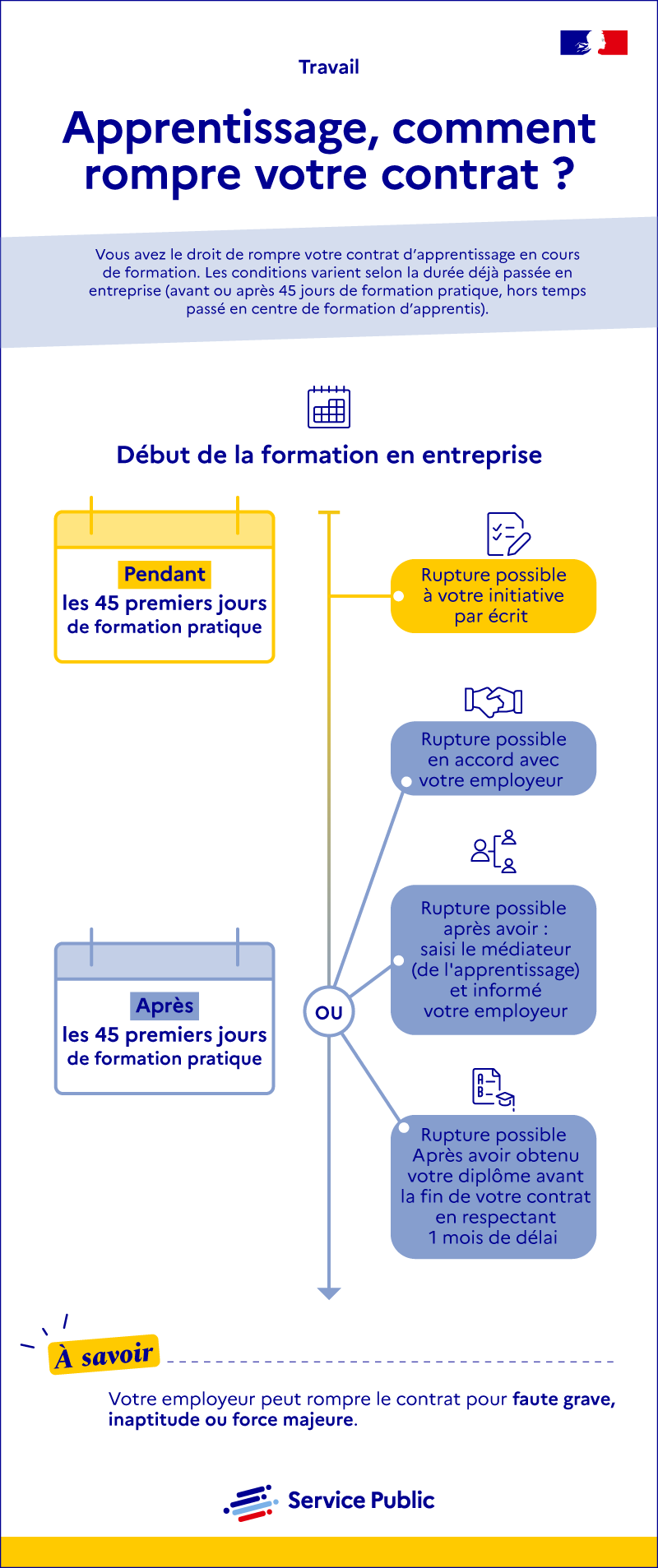
Infographie - How to break the apprenticeship contract?
Ouvrir l’image dans une nouvelle fenêtre
How to break the apprenticeship contract?
You have the right to break your apprenticeship contract during training. Conditions vary depending on how long you have been in company.
Beginning of hands-on company training
Case 1
During the first 45 days of practical training
Possible breakup at your initiative - in writing
Case 2
After the first 45 days of practical training
Possible breakup in agreement with your employer
Or
Possible breakup after referring the matter to the mediator (apprenticeship) and informing your employer
Or
Possible termination if you graduate and provided you inform your employer in writing at least 1 month before the end of the envisaged contract
The procedure varies depending on whether the contract is terminated before or after the first 45 days of hands-on training in the company:
Répondez aux questions successives et les réponses s’afficheront automatiquement
In the first 45 days
The contract can be broken in writing by the employer or by the apprentice.
This rupture must occur before the end of 45 first days in-company training, even if they are not consecutive.
After 45 days
The contract may be terminated after 45 days and in writing in any of the following cases:
- Joint agreement between employer and apprentice
- By the apprentice who must first seize the mediator. He then informs his employer after a minimum period of 5 calendar days. The termination of the contract takes place after a minimum period of 7 calendar days after informing the employer.
- By the apprentice who graduates before the initial deadline provided that he informs his employer in writing 1 month in advance. The termination may not take place before the day following the date of publication of the results.
- By the employer for gross negligence, incapacity, force majeure and final exclusion of the apprentice from the CFA, respecting the procedure of dismissal on personal grounds
- In the event of the death of an employer learning master of a single-person company, respecting the procedure of dismissal on personal grounds.
Following the termination of his contract, an apprentice who has not found a new employer can continue his theoretical training for 6 months in CFA. In this case, he/she shall have the status of vocational training trainee. It retains its social rights.
Where the apprenticeship contract is terminated before its expiry, the employer shall notify the employer of the termination without delayOpco: titleContent, which shall inform the services of the Minister responsible for vocational training. The notification can be done by dematerialized means.
FYI
In the event of the judicial liquidation of a company without continuing its activity, the apprenticeship contract may be terminated by the liquidator. The apprentice is entitled to compensation at least equal to the remuneration he would have received until the end of the contract.
In the event of a serious risk to the health or physical or moral integrity of the apprentice, the apprenticeship contract may be suspended.
These may include the following situations, for example:
- Brutality
- Physical or moral violence
- Insults, humiliations
- Non-compliance of company facilities
- Psychological harassment
- Sexual harassment.
When the labor inspector if he is aware of a dangerous situation, he shall carry out an investigation.
He may propose a suspension of the employment contract to the departmental director in charge of employment, labor and solidarity (DDETS: titleContent or DDETSPP: titleContent). The employer is informed of the suspension of the contract.
During this suspension, the apprentice's remuneration is maintained by the employer. The apprentice continues to take the general training in CFA.
The departmental director must decide whether or not to resume performance of the apprenticeship contract.
This decision must be made within 15 days of the finding of the labor inspector.
When the DDETS: titleContent or DDETSPP: titleContent refuses to allow the apprentice to return to his company, the apprenticeship contract is automatically terminated. The CFA can help him find a new employer.
There are 3 possible situations:
Répondez aux questions successives et les réponses s’afficheront automatiquement
The contract does not continue with the employer
The employer must provide the apprentice with:
- Work Certificate
- Attestation France Travail (formerly Pôle emploi)
- Balance of any account
- Possibly, a summary of all funds and securities saved under participation schemes, incentives or employee savings plans implemented within the company.
The apprentice is hired by the employer
When the apprentice continues his activity in the company at the end of his apprenticeship contract by signing an employment contract (DTA: titleContent, FIXED-TERM: titleContent or temporary employment contract) the following shall apply:
- No trial period may be imposed (unless otherwise agreed)
- Duration of apprenticeship taken into account for the calculation of remuneration
- Duration of the apprenticeship taken into account for the employee's seniority rights.
The contract is extended following the failure of the examination
In case of agreement between the apprentice, the employer and the CFA, the contract may be extended for a maximum of one year to allow for repetition in the event of failure to obtain the diploma or reorientation. In this case, the minimum wage applicable shall be that corresponding to the last year preceding that extension.
Who can help me?
Find who can answer your questions in your region
Allô Service Public - Renseignement administratif par téléphone
For more information on this subject, you can contact Allô Service Public.
Please note: the service does not have access to users' personal files and cannot therefore provide information on their progress.
He does not respond questions concerning unemployment compensation and the approach to the France Labor (formerly Pôle emploi), public servants or contract workers of the fCivil Service, the amount or payment of contributions social, wage or employer.
- Lundi : de 08h30 à 17h30
- Mardi : de 08h30 à 12h15
- Mercredi : de 08h30 à 12h15
- Jeudi : de 08h30 à 17h30
- Vendredi : de 13h00 à 16h15
- Service Free
The informants who answer you belong to the ministry responsible for labor.
To get help finding an apprenticeship contract
Youth InformationTo get help finding an apprenticeship contract
Local MissionTo be accompanied in the search for a training or an employer
Regional inter-ministerial learning support units
Paid annual leave under 21 years of age
Distance learning
Definition and regime of the apprenticeship contract
Age requirements of the apprentice
Conclusion of the apprenticeship contract
Contract Term (L6222-7)
Succession of apprenticeship contracts
Termination of the apprenticeship contract
Apprenticeship contract preparing for the vocational baccalaureate
Apprenticeship working hours (conditions, exceptions)
Minimum Wage
Presentation, exam preparation, additional leave
International and European mobility of apprentices
Master of Learning
Suspension of the apprenticeship contract and prohibition of recruitment
Companies of temporary work
Follow-up of distance learning
Apprenticeship bonus
Contributions and exemptions
Prohibited and regulated work for young people aged 15 and under and under 18
Derogations from the apprentice age limit
Minimum wage: reference rate in relation to the minimum wage
Contract filing in the private sector
Lump-sum compensatory allowance
Exemption from social security contributions
Submission of the contract in the non-industrial and commercial public sector
Sectors derogating from the working hours of young workers
Occupational Medicine Hiring Examination
Enhanced medical supervision for minors
Conclusion of the apprenticeship contract (number of copies, salary setting, etc.)
Agreement on the duration of the contract
Termination of the apprenticeship contract
Enhanced medical surveillance
Mobility within or outside the European Union
Master of Learning
Suspension on proposal of labor inspector
Master of learning in temporary work companies
Organization of learning
Formulaire
FAQ
Ministry of Labor
Ministry of Labor
Ministry of Labor
Ministry of Education
Ministry of Vocational Training
Ministry of Labor
National old-age insurance fund
Ministry of Labor