


File a complaint
Verified 08 July 2026 - Public Service / (Prime Minister)
Additional cases ?
You're a victim of a offense and you want to file a complaint? We show you how to do it.
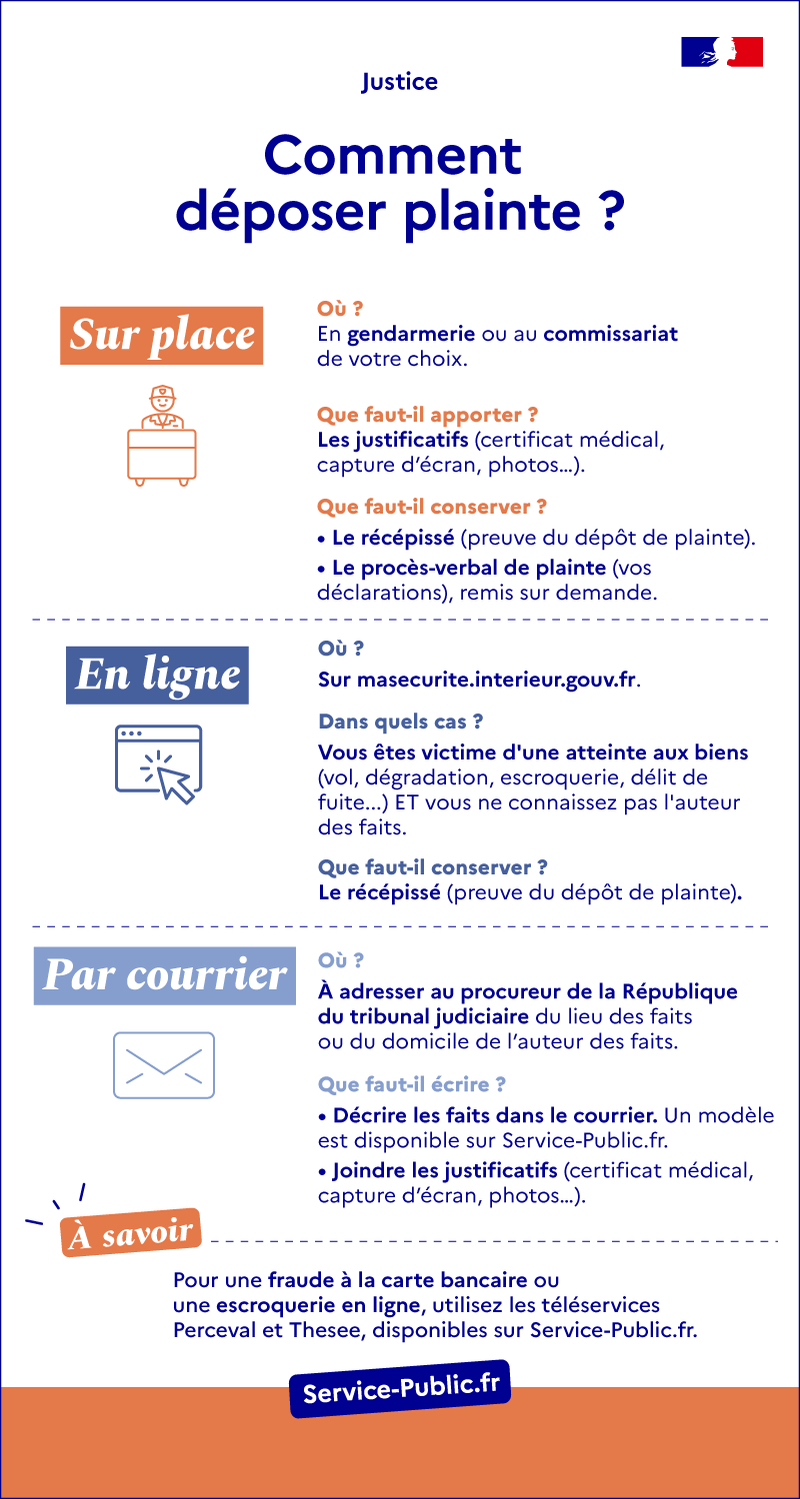
Infographie - How to file a complaint?
Ouvrir l’image dans une nouvelle fenêtre
Case 1 On the spot
Where? In the gendarmerie or police station of your choice
What should we bring? Proofs (medical certificate, screenshot, photos ...).)
What should be kept?
- The receipt (proof of filing of complaint).
- the complaint report (your statements) provided upon request.
Case 2 Online
Where? On masecurite.interieur.gouv.fr
In which cases? You are the victim of property damage (theft, damage, fraud, hit-AND-run...) AND you do not know the perpetrator.
What should be kept? The receipt (proof of filing of complaint).
Case 3 By post
Where? To be addressed to the public prosecutor of the judicial court of the place of the facts or the domicile of the perpetrator of the facts.
What should I write?
· Describe the facts in the mail. A template is available on Service-Public.fr.
· Attach supporting documents (medical certificate, screenshot, photos...))
To know
For credit card fraud or online scams, use the Perceval and Thesee online services, available on Service-Public.fr.
You can go to a police station or the gendarmerie or do the procedure by mail or online (in some cases) or, for certain offenses, using the video complaint:
On site
You have to surrender in a police station or to the gendarme of your choice.
FYI
Police or gendarmerie services are obliged to register your complaint if you are a victim of an offense.
The officers and judicial police officers must receive your complaint even if the facts do not fall within their geographical area of jurisdiction.
At the end of your hearing by the police or gendarmerie, you receive a receipt and a copy of your complaint if you request it.
Online
Online complaint is possible only in some cases.
You are a victim of property damage (theft, damage, fraud, hit-and-run...))
You don't know the perpetrator
You can use the service of online complaint if you are a victim of any of the following offenses:
- Theft, burglary
- Abuse of trust
- Scam (except for some internet scams)
- Hit-and-run (the failure of the driver of any vehicle to stop knowing that it has caused or caused an accident)
- Destruction, deliberate degradation or unintentional
- Offenses relating to unsafe deposit or garbage collection
- Forced mail order.
The complaint can be made online using the following service:
Depending on the elements declared, you can be contacted by a policeman or a gendarme to complete your declaration in the police station or gendarmerie.
Your report is processed by an officer who determines if it meets the requirements for a complaint report.
If your declaration is accepted, you are informed that a digital copy of the notice of complaint is posted online.
Otherwise, you will receive an email with the reason for rejecting your declaration.
You know the perpetrator
You cannot file a complaint online. You have to file a complaint on-site or by post.
You are the victim of an internet scam (THESEE)
You can file a complaint online on THESEUS only in the following cases
- You're a victim of a ransomware
- Your e-mail has been hacked and your identity has been usurped to connect with your contacts
- You are a victim of phishing (phishing)
- You bought on a fake commercial site
- You bought from a fake seller on a classifieds site (classified ad scam)
- You're being blackmailed
- You are a victim of blackmail or threats during a romantic or friendly relationship on the internet.
Use of the THESEE online service is recommended, but is not an obligation. The police or gendarmerie cannot force you to use this tool.
The statement made on THESEE is then forwarded to the national police.
Warning
If you are not in a case provided by the online service THESEE, you cannot file a complaint online. You can use the online complaint service if you do not know the perpetrator or file a complaint on-site or by post or possibly by videocomplaint.
You are a victim of another offense
You cannot do not complain online.
You have to file a complaint on-site or by post.
By post
You can file a complaint with the public prosecutor.
To do this, you need to send a letter to court of the place of the offense or of the domicile of the offender.
Who shall I contact
Your mail should include the following:
- Your marital status and full contact details (address and telephone number)
- Detailed account of the facts, date and place of the offense
- Name of the alleged perpetrator if you know him (otherwise, the complaint will be filed against X)
- Name and address of any witnesses to the offense
- Description and provisional or definitive estimate of injury
- Your proof documents: medical certificates, work stoppages, photographs, videos, various invoices, statements...
You can use the following mail template:
File a complaint with the public prosecutor
You can send your complaint by mail or file it directly at the reception of the court.
By videocomplaint
For certain offenses, you can file a complaint with a police officer or gendarme by videoconference.
The visiocomplaint can be performed from your home or in a place where you are not exposed to others. It requires authentication from the FranceConnect portal. Your computer, tablet or phone must be equipped with built-in camera or a webcam to carry out the visiocomplaint.
You choose an appointment slot depending on your schedule and availability of the service from the following online service:
Warning
Visiocomplaint is not possible for all offenses. You must check your situation to see if your violation and the availability of the service allows it.
You can file a complaint against a natural person or a legal person (a company, an association...).)
If you do not know the perpetrator or if you are unsure of their identity, you can still file a complaint. In this case, your complaint must be filed against X.
FYI
You may be accompanied by a lawyer to file a complaint.
You can file a complaint if you are a victim of a offense.
Any person (adult, minor or protected major) may lodge a complaint.
If you represent a legal entity (business, association)...), you can also file a complaint on behalf of the organization.
You must be a victim of a offense, i.e. a crime, of a offense or a contravention to be able to file a complaint. We are talking about criminal litigation.
Not all disputes are the subject of a complaint. Some disputes are only civilians or administrative because there is no offense.
Example :
You have not received a product ordered on the Internet: this dispute is civil. It can become criminal if you ordered on a fraudulent site. In this case, you are the victim of a scam.
FYI
You don't have to qualify the offense you are the victim of when you file a complaint (for example, saying you are the victim of a scam). You just have to describe what happened to you without defining what the offense is.
You must file a complaint before the end of the limitation period.
The limitation periods are as follows:
- 1 year for the tickets (abnormal neighborhood disorder, no injuries ITT: titleContent ...)
- 6 years for the offenses (theft, assault, fraud, non-representation of ...) child
- 20 years for the crimes (murder, rape, armed robbery ...).)
If the facts are prescribed, your complaint can no longer succeed.
FYI
For certain specific infringements, these time limits may be reduced or extended. For example, the statute of limitations for an insult is 3 months, while the statute of limitations for terrorism is 30 years.
The limitation period starts in principle from the day on which the offense was committed.
For a crime against a minor, a new time limit starts from the majority of the victim. For example, a minor victim of rape may lodge a complaint up to the age of 48, i.e. 30 years after reaching the age of majority (a special period of 30 years starting with the age of majority).
Complaining is free.
The complaint triggers a police investigation. The investigation may be followed by a possible judgment of the perpetrator by the court.
Police investigation
The filing a complaint triggers a criminal investigation entrusted to the police or gendarmerie.
The investigation verifies the existence of the offense and identifies the perpetrator.
At the end of the investigation, the public prosecutor may take one of the following decisions:
- Close the case without further action
- Propose a alternative measure to prosecution
- Open a judicial information
- Have the suspect tried by a criminal jurisdiction.
Judgment of the case
If the perpetrator is found guilty by the court, he is sentenced to a criminal penalty (prison, fine...).) Otherwise, it is relaxed or acquitted.
If you have civil party, the perpetrator may also be ordered to make good your damage (by payment of damages for example).
FYI
You can have a person you consider to be a victim summoned before the criminal judge by a direct quote. You don't have to have filed a complaint before.
Who can help me?
Find who can answer your questions in your region
To exchange with a gendarme or a police officer, 24/7, by instant messaging
I talk to a policeman or a gendarmeFor more information on this subject, you can contact Allô Service Public.
Please note: the service does not have access to users' personal files and cannot therefore provide information on their progress.
- Lundi : de 08h30 à 17h30
- Mardi : de 08h30 à 12h15
- Mercredi : de 08h30 à 12h15
- Jeudi : de 08h30 à 17h30
- Vendredi : de 13h00 à 16h15
- Service free
The informants who answer you belong to the Department of Justice.
This service allows victims of infringements (excluding damage to property on the internet) to be listened to and referred to a victim support association or a specialized service. It is accessible to deaf and hard of hearing people.
In metropolitan France
116,006
Free call
Service available every day of the year, from 9am to 8pm.
Outside metropolitan France (or from the foreigner)
+ 33 (0)1 80 52 33 76
Free call
Service reachable every day of the year, from 9am to 8pm (Paris time).
By email
By email: victimes@116006.fr
Listen, inform and guide women victims of violence, and witnesses to such violence.
Deals with physical, verbal or psychological violence, at home or at work, and of any kind (including sexual harassment, assault and rape).
Does not deal with emergencies (this is not a police or gendarmerie service).
For other types of violence, 3919 provides a first-level response and directs or forwards to a useful number.
By phone
39.19 (free call from a landline or mobile phone in metropolitan and DOM)
Open 24 hours a day, 7 days a week
Anonymous call
Call not listed on phone bills
Public action and civil action
Filing a complaint with the judicial police (Article 15-3)
Submission of a complaint to the public prosecutor (article 40) and follow-up to a complaint (article 40-1)
Online service
Modèle de document
Online service
FAQ
Service Public
Ministry of Justice