


Seize the labor court (CPH)
Verified 03 March 2026 - Public Service / Directorate of Legal and Administrative Information (Prime Minister)
The labor court shall regulate the individual disputes between an employer and an employee arising in connection with any employment contract. What are the steps to be done to enter it? We're taking a look at the regulations.
The labor court may be seised by the employee or by theemployer.
Employee
The labor court is the alone court competent to settle any dispute individual between you and your employer.
This dispute may arise during whether you work for your employer or at the time of rupture of your employment contract.
You can apply to the labor court if you have a contract of employment private law. This concerns, for example, the following persons:
- Employees (journalists, entertainers, models, salespeople, etc.)
- Apprentices or employees on a professional contract
- Maternal and family assistants
- Persons bound by an assisted contract (employment support contract, future contract, integration contract, etc.)
- Staff of public industrial and commercial establishments (e.g. RATP and social security funds)
- Employees of a State of the european union temporarily posted to France.
FYI
The labor court is not competent to resolve a dispute:
- On relations collective working
- Or linked to a contract of employment of public law (on administrative tribunal is competent)
- Or in matters of occupational accidents and diseases.
You can resort to the labor court in case of individual dispute linked, for example:
- To a breach of the employment contract
- To disciplinary action
- Payment of salary or bonuses
- To working hours
- On days of rest or leave
- The health and safety conditions of the workstation
- Upon delivery of the France Travail certificate (formerly Pôle emploi), the work certificate or the receipt for the balance of any account
- A situation of harassment (moral or sexual) or discrimination
- At the conclusion of the contract (non-compliance with a promise to hire, for example)
- The requalification of professional relations as an employment contract.
For the action to be admissible, you must enter the CPH in a certain timeframe. This varies according to the nature of the dispute. Beyond that, the facts are prescribed.
Répondez aux questions successives et les réponses s’afficheront automatiquement
Action relating to breach of employment contract
You may refer the matter to the labor court within 12 months.
This period shall be calculated from the date of notification the breach of contract.
This period applies in particular in the event of failure to provide the employee with documents related to the termination of the employment contract:attestation France Travail (formerly Pôle emploi), work certificate, balance of any account.
This period shall also apply in the following cases:
- Challenging the regularity or validity of an economic dismissal if the employment protection plan (PSE) is not validated, or approved
- Dispute over the termination of the employment contract following the accession to a professional security contract (CSP). In this case, the deadline is calculated from the date of accession to the CSP.
Action relating to the performance of the employment contract
You may refer the matter to the labor court within 2 years.
This period shall be calculated from the day on which the person exercising it knew or ought to have known the facts enabling him to exercise his right.
Dispute of a conventional breach
You may refer the matter to the labor court within 12 months to challenge a conventional rupture approved.
This period shall be calculated from date of approval of the Convention of Termination.
Payment of salaries
You may refer the matter to the labor court within 3 years in the context of an action to obtain payment of sums due, in particular in the case of:
- Salary not paid
- Unpaid overtime
- Premiums not paid.
This period is calculated from the date of chargeability of the payroll claim.
Example :
An employee is paid monthly and usually on 2 of each month. The November 2, 2024Yeah, his salary's not paid. So he has 3 years from November 2, 2024 to make an action in the labor court.
FYI
The deadline is reduced to 6 months if you dispute an amount mentioned in the receipt for balance of any account, that you have signed. If he is not signed, you have a deadline set at 3 years.
Harassment or discrimination
You have a deadline of 5 years to refer to the labor court any action due to a psychological harassment or a sexual harassment or a discrimination.
In case of harassment, the time limit shall be calculated from the date of the last offense and shall apply to previous offenses which may be classified as harassment.
In case of discrimination, the period shall run from the date on which the discriminatory act is revealed.
Bodily injury
In the event of bodily injury occurring during work, you have a fixed deadline 10 years to refer the matter to the labor court. This period shall be calculated from the date of damage consolidation.
You must address the labor court:
- Or the place where is located the establishment in which you perform your work, work location where the employment contract was concluded or head office from the company that employs you
- Either, if you work at home or in out of everything establishment, of location of your home
- Either the place where the undertaking was entered into or the place where the employer is established.
Who shall I contact
To make your request, you can submit your query on free paper or fill in a query form for the purpose of referral to the labor court.
A query form template is available:
Request for referral to the Labor Court (CPH) by an employee
It is addressed only by way of query, that is to say, a claim made to the judge with the aim of settling the dispute with your employer.
Your request can be addressed to graft of the labor court by mail (recommended or not). It may also be deposited directly at the registry.
Your request, dated and signed, shall include the following:
- Your contact details (surname, first name(s), address...)
- Contact details of defendant (employer against whom the application is made)
- Object of the request
- Summary presentation the reasons for your request. It must mention all of your pretensions (amounts claimed).
Your request must be accompanied documents that you wish to rely on in support of your claims.
These parts are listed on a communication slip of parts annexed to it.
You must file or send your request and the slip to graft in so many copies so many defendants.
A copy for the Registry should also be attached.
You have to pay a fiscal stamp from €50 to bring your claim to justice, unless you are a beneficiary of legal aid.
This electronic tax stamp can be purchased online only. Payment is made by credit card.
Purchase an electronic tax stamp to initiate civil legal proceedings
Warning
The contribution must be paid at the time of the application for judicial proceedings. In the event of non-payment, you will be given a period of 1 month to adjust your payment. After this period, your request is considered as inadmissible and you'll have to reapply.
No, you can introduce yourself alone at the hearing of the labor court.
You may also be assisted or represented by a employee or a employer belonging to the same industry, your husband, partner of civil solidarity pact or cohabiting partner.
You can also use a lawyer for you assist or represent you.
However, the presence of a lawyer is not required. If you choose a lawyer, you can request the benefit of thelegal aid, provided that this lawyer accepts.
One union advocate may also represent or assist you in your capacity free.
FYI
The representative, if he is not not a lawyer, must justify in writing that authorizes it to act on your behalf and for your account.
Within the framework of the progress of the case, an initial phase of conciliation takes place between you and your employer.
In case of full reconciliation, the dispute shall take end.
If conciliation is not not possible, the unresolved elements of the case shall then be the subject of a judgment.
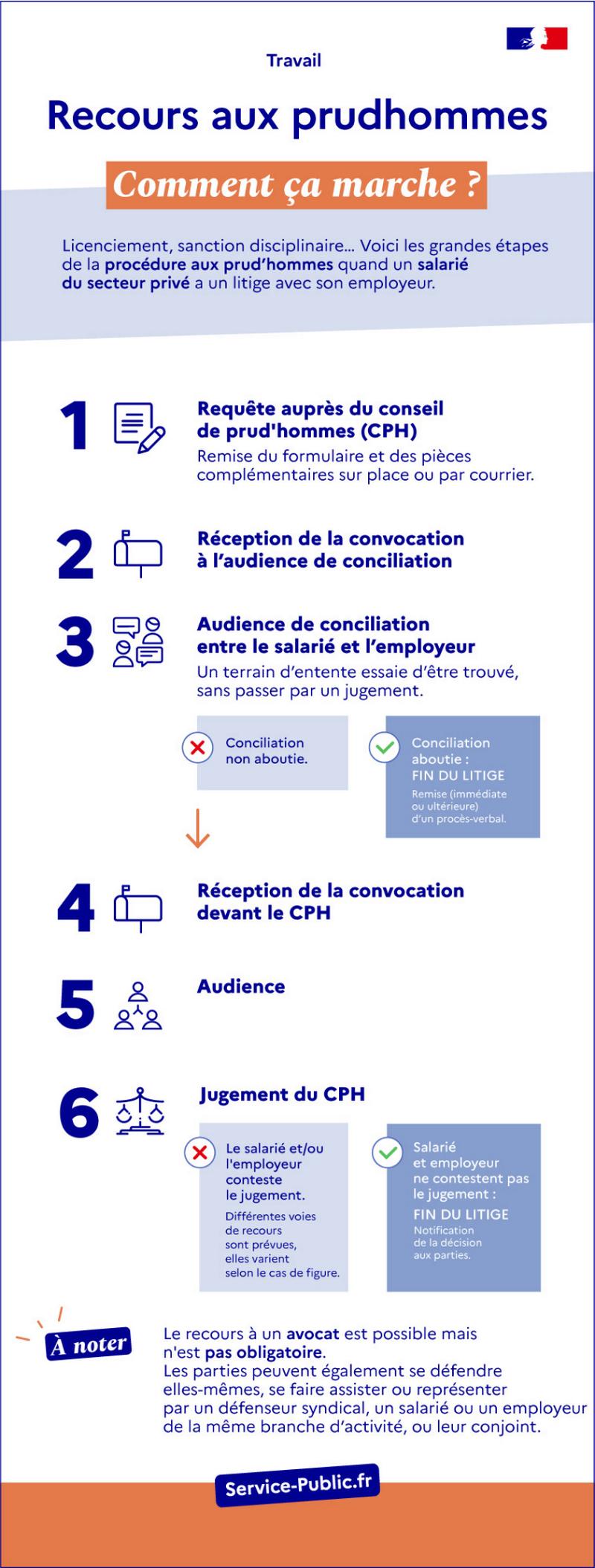
Infographie - Recourse to labor courts, how does it work?
Ouvrir l’image dans une nouvelle fenêtre
RECOURSE TO THE LABOR COURTS
How does it work?
Dismissal, disciplinary action...
Here are the main steps of the labor court procedure when a private sector employee has a dispute with his employer.
1. Application to the Labor Court (CPH)
Delivery of the form and additional documents on site or by post.
2. Receipt of the notice to the conciliation hearing
3. Conciliation hearing between employee and employer
A common ground is trying to be found, without going through a judgment.
- Conciliation completed: end of the dispute
Issuance (immediate or subsequent) of minutes.
- Conciliation not completed
4. Receipt of the summons before the HPC
5. Hearing
6. Judgment of the CPH
- Employee and employer do not contest the judgment: end of the dispute
Notification of decision to parties.
- The employee and/or the employer disputes the judgment
Different avenues of appeal are provided, they vary depending on the situation.
Note:
The use of a lawyer is possible but not mandatory.
The parties may also defend themselves, be assisted or represented by a trade union advocate, an employee or an employer in the same industry, or their spouse.
Employer
The labor court is the alone court competent to settle any dispute individual between you and your employee. This dispute may arise during the contract is in progress or at the time of rupture the employment contract.
You can refer the matter to the labor court if you are an employer under the private law or if you employ persons under private law conditions.
FYI
The labor court is not competent to resolve a dispute:
- On relations collective of work,
- Or linked to a contract of employment of public law (on administrative tribunal is competent).
You can use the labor court in case of a related conflict, for example:
- To a job abandonment of your employee
- At notice not given
- Theft or damage to company property
- Failure to comply with a non-compete clause
- The refusal to repay an overpayment
- To the challenge of medical elements issued by the occupational physician in the context of an incapacity.
Répondez aux questions successives et les réponses s’afficheront automatiquement
Action relating to the performance of the employment contract
You may refer the matter to the labor court within 2 years.
This period shall be calculated from the day on which the person exercising it knew or ought to have known the facts enabling him to exercise his right.
Payment of salaries
You may refer the matter to the labor court within 3 years in the context of an action to obtain payment of sums due (reimbursement of an overpayment for example).
This period is calculated from the date of chargeability of the payroll claim.
Example :
In the event of refusal to reimburse an overpayment of salary of October 2024, paid on November 2, 2024so the employer has 3 years from November 2, 2024 to make an action in the labor court.
You must address the labor court:
- Or the place where is located the establishment in which the employee carries out his work, location where the employment contract was concluded or head office of the company.
- Either, if your employee works at his home or in out of everything establishment, of location of sound home.
How do I submit the application?
To make your request, you can submit your query on free paper or fill in the query form for the purpose of referral to the labor court.
A form template is available:
Application for referral to the Labor Court (CPH) by an employer
It is addressed only by way of query, i.e. a claim made to the judge with the aim of settling the dispute with your employee.
Your request can be addressed to graft of the labor court by mail (recommended or not). It may also be deposited directly at the registry.
Your request, dated and signed, shall include the following:
- Your contact details (surname, first name(s), address...)
- Contact details of defendant (employee against whom the request is made)
- Object of the request
- Summary presentation the reasons for your request. It must mention all of your pretensions (amounts claimed).
Your request must be accompanied documents that you wish to rely on in support of your claims.
These parts are listed on a communication slip of parts annexed to it.
You must file or send your request and the slip to graft in so many copies so many defendants.
A copy for the Registry should also be attached.
You have to pay a fiscal stamp from €50 to bring your claim to justice.
This electronic tax stamp can be purchased online only. Payment is made by credit card.
Purchase an electronic tax stamp to initiate civil legal proceedings
Warning
The contribution must be paid at the time of the application for judicial proceedings. In the event of non-payment, you will be given a period of 1 month to adjust your payment. After this period, your request is considered as inadmissible and you'll have to reapply.
No, you can introduce yourself alone at the hearing of the labor court.
You may also be assisted or represented by a employer or an employee belonging to the same industry. You can request your spouse, partner of Civil partnerships, cohabiting partner and also a member of your company.
You can use a lawyer for assist or represent you. However, the presence of a lawyer is not required.
One union advocate (patronal) may also represent or assist you in your capacity free.
FYI
The representative, if he is not not a lawyer, must justify in writing that authorizes it to act on your behalf and for your account.
Within the framework of the progress of the case, a phase initial from conciliation takes place with your employee.
In the event of conciliation total, the dispute shall take end.
If conciliation is not not possible, the unresolved elements of the case are then the subject of a judgment.
Infographie - Recourse to labor courts, how does it work?
Ouvrir l’image dans une nouvelle fenêtre
RECOURSE TO THE LABOR COURTS
How does it work?
Dismissal, disciplinary action...
Here are the main steps of the labor court procedure when a private sector employee has a dispute with his employer.
1. Application to the Labor Court (CPH)
Delivery of the form and additional documents on site or by post.
2. Receipt of the notice to the conciliation hearing
3. Conciliation hearing between employee and employer
A common ground is trying to be found, without going through a judgment.
- Conciliation completed: end of the dispute
Issuance (immediate or subsequent) of minutes.
- Conciliation not completed
4. Receipt of the summons before the HPC
5. Hearing
6. Judgment of the CPH
- Employee and employer do not contest the judgment: end of the dispute
Notification of decision to parties.
- The employee and/or the employer disputes the judgment
Different avenues of appeal are provided, they vary depending on the situation.
Note:
The use of a lawyer is possible but not mandatory.
The parties may also defend themselves, be assisted or represented by a trade union advocate, an employee or an employer in the same industry, or their spouse.
Request for referral to the Labor Court (CPH) by an employee
Who can help me?
Find who can answer your questions in your region
For legal advice
House of Justice and LawFor information on labor law
Departmental Directorate in charge of employment, labor and solidarity (DDETS or DDETS-PP)
Adherence to a professional security contract (CSP)
Receipt for balance of any account
Regularity or validity of economic dismissal
Conventional breach (Article L1237-14)
Powers of the Labor Court
Execution or termination of employment contract, harassment, discrimination
Payment of salaries
Filing of the application, summons of the applicant and the defendant
Bodily injury
Contribution for legal aid