

What is the income tax scale?
Verified 15 April 2026 - Public Service / (Prime Minister)
The scale shall be used for calculating your tax.
He is progressive.
It comprises multiple income brackets, which each correspond to one different tax rate, which varies from 0% à 45%.
To apply the tax scale to your taxable income, you must take into account family quotient, i.e. your number of shares, which depends on your situation and the number of people in your tax household.
Please note
The tax scale is fixed every year. For example, the 2026 scale (applicable to 2025 income) is set by the Finance Act for 2026.
Income bands | Tax rate of income bracket |
|---|---|
Up to €11,600 | 0% |
From €11,601 à €29,579 | 11% |
From €29,580 à €84,577 | 30% |
From €84,578 à €181,917 | 41% |
More than €181,917 | 45% |
The marginal tax rate (TMI) is the tax rate that applies to the highest slice of your income.
The average tax rate is the average rate at which your income is taxed. It tells you the share of your income tax.
Please note
The tax benefit for children is limited. It's the family quotient cap.
Here are some examples of calculations:
Répondez aux questions successives et les réponses s’afficheront automatiquement
For a bachelor
One single (single unit household) with a net taxable income of €30,000, without any reduction or deduction.
His family quotient is €30,000.
For the calculation of his tax:
- Up to €11,600 : 0%
- From €11,601 à €29,579 : (€29,579 - €11,600) × 11% = €17,979 × 11% = €1,977.69
- From €29,580 à €30,000 : (€30,000 - €29,579) x 30% = €421 × 30% = €126.30.
Its gross tax is: €0 + €1,977.69 + €126.30 = €2,103.99.
The marginal tax rate (MIR) of this taxpayer is 30%, because his family quotient puts him in that bracket. But not all of his income is taxed at 30%.
Its average tax rate is 7.01% (2 103.99: 30 000).
For a married or entered into a civil partnership couple without children
Net taxable income of €60,000
One married or entered into a civil partnership without children (household of 2 units) with taxable net income of €60,000.
His family quotient is €60,000 : 2 = €30,000.
For the calculation of his tax:
- Up to €11,600 : 0%
- From €11,601 à €29,579 : (€29,579 - €11,600) × 11% = €17,979 × 11% = €1,977.69
- From €29,580 à €30,000 : (€30,000 - €29,579) x 30% = €421 × 30% = €126.30.
The gross tax of each member of the couple is: €0 + €1,977.69 + €126.30 = €2,103.99.
This tax must be multiplied by the number of shares in the tax household. In this example, it will be multiplied by 2, since it is a married or entered into a civil partnership couple.
The couple will therefore have to pay a tax of €2,103.99 × 2, or €4,207.98.
The marginal tax rate (MTR) of this couple is 30%, because his family quotient puts him in that bracket. But not all of his income is taxed at 30%.
Its average tax rate is 7.01% (4 207,98: 60 000).
Net taxable income of €90,000
One married or entered into a civil partnership without children (household of 2 units) with taxable net income of €90,000.
His family quotient is €90,000 : 2 = €45,000.
For the calculation of his tax:
- Up to €11,600 : 0%
- From €11,601 à €29,579 : (€29,579 - €11,600) × 11% = €17,979 × 11% = €1,977.69
- From €29,580 à €45,000 : (€45,000 - €29,579) x 30% = €15,421 × 30% = €4,626.30.
The gross tax of each member of the couple is: €0 + €1,977.69 + €4,626.30 = €6,603.99.
This tax must be multiplied by the number of shares in the tax household. In this example, it will be multiplied by 2 since it is a married or entered into a civil partnership couple.
The couple will therefore have to pay a tax of €6,603.99 × 2, or €13,207.98.
The marginal tax rate (MTR) of this couple is 30%, because his family quotient puts him in that bracket. But not all of his income is taxed at 30%.
Its average tax rate is 14.67% (13 207.98: 90 000).
For a married or entered into a civil partnership couple with 1 child
Net taxable income of €60,000
One married or entered into a civil partnership couple with 1 child (focus of 2.5 shares, 1 share for each parent and 1 half share for the child) with taxable net income of €60,000.
His family quotient is €60,000 : 2.5 = €24,000.
For the calculation of his tax:
- Up to €11,600 : 0%
- From €11,601 à €24,000 : (€24,000 - €11,600) x 11% = €12,400 × 11% = €1,364.
This tax must be multiplied by the number of shares in the tax household. In this example, it will be multiplied by 2.5 since it is a married or entered into a civil partnership couple with 1 child.
The couple with 1 child should therefore pay a tax of: €1,364 x 2.5, or €3,410.
The couple is entitled to a maximum tax benefit of €1,807 for his child (this is the family quotient cap).
As a reminder, a married or entered into a civil partnership couple without children who received a net taxable income of €60,000 shall pay a tax of €4,207.98.
Thus, the advantage linked to the child is €797.98 (€4,207.98 - €3,410).
The amount of this benefit is less than the maximum benefit of €1,807.
The couple with 1 child will therefore owe a tax of €3,410.
The marginal tax rate (MTR) of this couple with 1 child is 11%, because his family quotient puts him in that bracket. But not all of his income is taxed at 11%.
Its average tax rate is 5.68% (3 410: 60 000).
Net taxable income of €90,000
One married or entered into a civil partnership couple with 1 child (focus of 2.5 shares, 1 share for each parent and 1 half share for the child) with taxable net income of €90,000.
His family quotient is €90,000 : 2.5 = €36,000.
For the calculation of his tax:
- Up to €11,600 : 0%
- From €11,601 à €29,579 : (€29,579 - €11,600) × 11% = €17,979 × 11% = €1,977.69
- From €29,580 à €36,000 : (€36,000 - €29,579) x 30% = €6,421 × 30% = €1,926.30.
The gross tax of each member of the couple is: €0 + €1,977.69 + €1,929.30 = €3,903.99.
This tax must be multiplied by the number of shares in the tax household. In this example, it will be multiplied by 2.5 since it is a married or entered into a civil partnership couple with 1 child.
The couple with 1 child should therefore pay a tax of €3,903.99 × 2.5, or €9,759.97.
The couple is entitled to a maximum tax benefit of €1,807 for his child (this is the family quotient cap).
As a reminder, a married or entered into a civil partnership couple without children who received a net taxable income of €90,000 shall pay a tax of €13,207.98.
Thus, the advantage linked to the child is €3,448.01 (€13,207.98 - €9,759.97).
This amount exceeds the maximum tax benefit to which the couple is entitled for their child €1,641.01 (€3,448.01 - €1,807).
The couple with 1 child will therefore owe a tax of €11,400.98 (€9,759.97 + €1,641.01).
The marginal tax rate (MTR) of this couple with 1 child is 30%, because his family quotient puts him in that bracket. But not all of his income is taxed at 30%.
Its average tax rate is 12.67% (11 400.98: 90 000).
For a married or entered into a civil partnership couple with 2 children
Net taxable income of €60,000
One married or entered into a civil partnership couple with 2 children (focus of 3 shares, 1 share for each parent and 1 half share for each child) having received a net taxable income of €60,000.
His family quotient is €60,000 : 3 = €20,000.
For the calculation of his tax:
- Up to €11,600 : 0%
- From €11,601 à €20,000 : (€20,000 - €11,600) x 11% = €8,400 × 11% = €924.
This tax must be multiplied by the number of shares in the tax household. In this example, it will be multiplied by 3 since it is a married or entered into a civil partnership couple with 2 children.
The couple with 2 children should therefore pay a tax of: €924 x 3, or €2,772.
The couple is entitled to a maximum tax benefit of €3,614 (€1,807 x 2) for his 2 children (this is the family quotient cap).
As a reminder, a married or entered into a civil partnership couple without children who received a net taxable income of €60,000 shall pay a tax of €4,207.98.
Thus, the advantage related to the 2 children is €1,435.98 (€4,207.98 - €2,772).
The amount of this benefit is less than the maximum benefit of €3,614.
The couple with 2 children will therefore owe a tax of €2,772.
The marginal tax rate (MTR) of this couple with 2 children is 11%, because his family quotient puts him in that bracket. But not all of his income is taxed at 11%.
Its average tax rate is 4.62% (2 772: 60 000).
Net taxable income of €90,000
One married or entered into a civil partnership couple with 2 children (focus of 3 shares, 1 share for each parent and 1 half share for each child) having received a net taxable income of €90,000.
His family quotient is €90,000 : 3 = €30,000.
For the calculation of his tax:
- Up to €11,600 : 0%
- From €11,601 à €29,579 : (€29,579 - €11,600) × 11% = €17,979 × 11% = €1,977.69
- From €29,580 à €30,000 : (€30,000 - €29,579) x 30% = €421 × 30% = €126.30.
The gross tax of each member of the couple is: €0 + €1,977.69 + €126.30 = €2,103.99.
This tax must be multiplied by the number of shares in the tax household. In this example, it will be multiplied by 3 since it is a married or entered into a civil partnership couple with 2 children.
The couple with 2 children should therefore pay a tax of €2,103.99 × 3, or €6,311.97.
The couple is entitled to a maximum tax benefit of €3,614 (€1,807 x 2) for his 2 children (this is the family quotient cap).
As a reminder, a married or entered into a civil partnership couple without children who received a net taxable income of €90,000 shall pay a tax of €13,207.98.
Thus, the advantage related to children is €6,896.01 ( €13,207.98 - €6,311.97).
This amount exceeds the maximum tax benefit to which the couple is entitled for their two children €3,282.01 (€6,896.01 - €3,614).
The couple with 2 children will therefore owe a tax of €9,593.98 (€6,311.97 + €3,282.01).
The marginal tax rate (MTR) of this couple with 2 children is 30%, because his family quotient puts him in that bracket. But not all of his income is taxed at 30%.
Its average tax rate is 10.66% (9 593.98: 90 000).
For a single parent with 1 child
One single parent with 1 child (2-share household, 1 share for the parent, 1 half-share for the child in principal residence and 1 additional half-share as a single parent) having received a net taxable income of €30,000.
His family quotient is €30,000 : 2 = €15,000.
- Up to €11,600 : 0%
- From €11,601 à €15,000 : (€15,000 - €11,600) x 11% = €3,400 x 11% = €374.
This tax must be multiplied by the number of shares in the tax household. In this example, it will be multiplied by 2 since it is a single parent with 1 child.
To note : the tax benefit is reduced by half in the case of alternating residence.
The gross family tax is: €374 x 2, or €748.
A single parent with 1 child is entitled to a maximum tax benefit of €4,262 for his child (this is the family quotient cap).
As a reminder, a single person without children who received a net taxable income of €30,000 shall pay a tax of €2,103.99.
Thus, the advantage linked to the child is €1,355.99 (€2,103.99 - €748).
The amount of this benefit is less than the maximum benefit of €4,262.
The single parent with 1 child will therefore have to pay a tax of €748.
The marginal tax rate (MTR) of this family is 11%, because his family quotient puts him in that bracket. But not all of his income is taxed at 11%.
Its average tax rate is 2.49% (748: 30,000).
For a single parent with 2 children
One single parent with 2 children (2.5-share household, 1 share for the parent, 1 half-share for each child in a principal residence and 1 additional half-share as a single parent) who received a net taxable income of €30,000.
His family quotient is €30,000 : 2.5 = €12,000.
- Up to €11,600 : 0%
- From €11,601 à €12,000 : (€12,000 - €11,600) x 11% = €400 x 11% = €44.
This tax must be multiplied by the number of shares in the tax household. In this example, it will be multiplied by 2.5 since it is a single parent with 2 children.
To note : the tax benefit is reduced by half in the case of alternating residence.
The gross family tax is: €44 x 2.5, or €110.
A single parent with 2 children is entitled to a maximum tax benefit of €6,069 (€4,262 + €1,807) for his 2 children (this is the family quotient cap).
As a reminder, a single person without children who received a net taxable income of €30,000 shall pay a tax of €2,103.99.
Thus, the advantage linked to the child is €1,993.99 (€2,103.99 - €110).
The amount of this benefit is less than the maximum benefit of €6,069.
The single parent with 2 children will therefore have to pay a tax of €110.
The marginal tax rate (MTR) of this family is 11%, because his family quotient puts him in that bracket. But not all of his income is taxed at 11%.
Its average tax rate is 0.36% (110: 30,000).
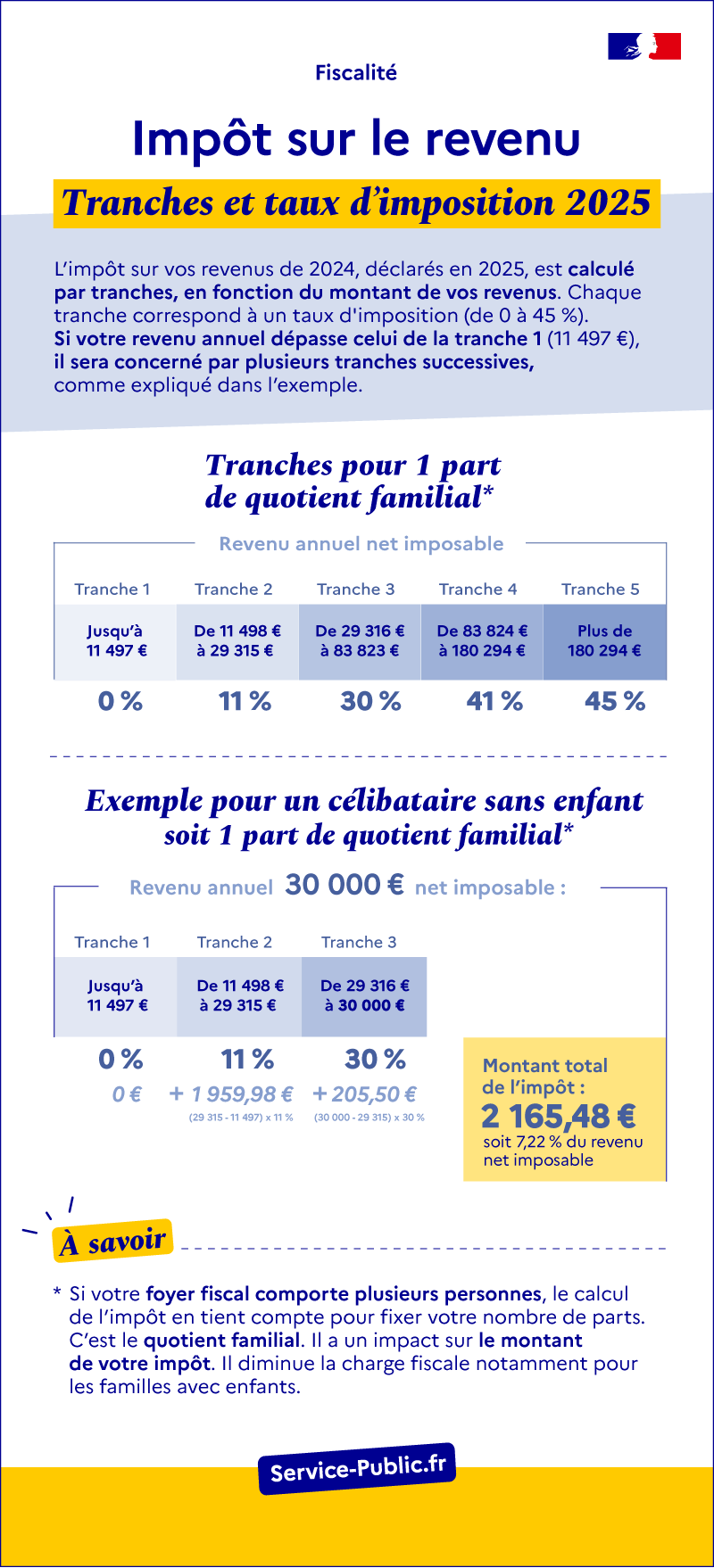
Infographie - Income tax: 2026 scale
Ouvrir l’image dans une nouvelle fenêtre
Income tax
2026 tax brackets and rates
Your tax is calculated in installments, based on the amount of your income. Each bracket corresponds to a tax rate (from 0 to 45%). If your annual income exceeds that of tranche 1 (€11,600), it will be covered by several successive tranches, as explained in the example.
Slices for 1 share of family quotient:
- Up to €11,600 (tranche 1): 0% tax rate
- From €11,601 to €29,579 (tranche 2): tax rate of 11%
- From €29,580 to €84,577 (tranche 3): tax rate of 30%
- From €84,578 to €181,917 (tranche 4): tax rate of 41%
- Over €181,917 (tranche 5): 45% tax rate
Example of calculation for 1 share of family quotient:
A single person (1 share) whose annual net taxable income is € 30,000, the calculation of his tax is as follows:
- Up to €11,600 (tranche 1): €0
- From €11 601 to €29 579 (tranche 2): €1 977.69, i.e. (29 579 – 11 600) x 11%
- From €29 580 to €30 000 (tranche 3): €126.30, i.e. (30 000 – 29 579) x 30%
Total amount of tax: € 2,103.99, or 7.01% of his net taxable income.
Namely: if your tax household has several people, the tax calculation takes this into account to determine your number of shares. That's the family quotient. This mechanism has an impact on the amount of your tax. In particular, it reduces the tax burden for families with children.
Warning
The scale is only one element of the calculation of income tax. You can make an estimate of your tax liability using the tax services simulator.
Who can help me?
Find who can answer your questions in your region
For general information
By phone:
0809,401,401
Monday to Friday from 8:30 am to 7 pm, excluding public holidays.
Free service + price call
To contact the local service managing your file
Tax department (treasury, tax department...))
Calculation of income tax
Amount below which tax is not assessed (Article 1657)
Online service
Online service
FAQ
Service Public
Ministry of Finance
Ministry of Finance