

Income tax - Works to adapt housing to the loss of independence due to age or disability (tax credit)
Verified 15 April 2026 - Public Service / (Prime Minister)
Did you have equipment works made in your home in 2025 for people with disabilities or seniors with a loss of autonomy? You can benefit, under conditions, from a tax credit for works made and invoiced before December 31, 2025. The tax credit is eliminated for expenses paid on or after 1er January 2026. We tell you what you need to know about your 2025 expenses.
Expenditure paid in 2025
The tax credit is now reserved for middle-income earners, who meet certain conditions.
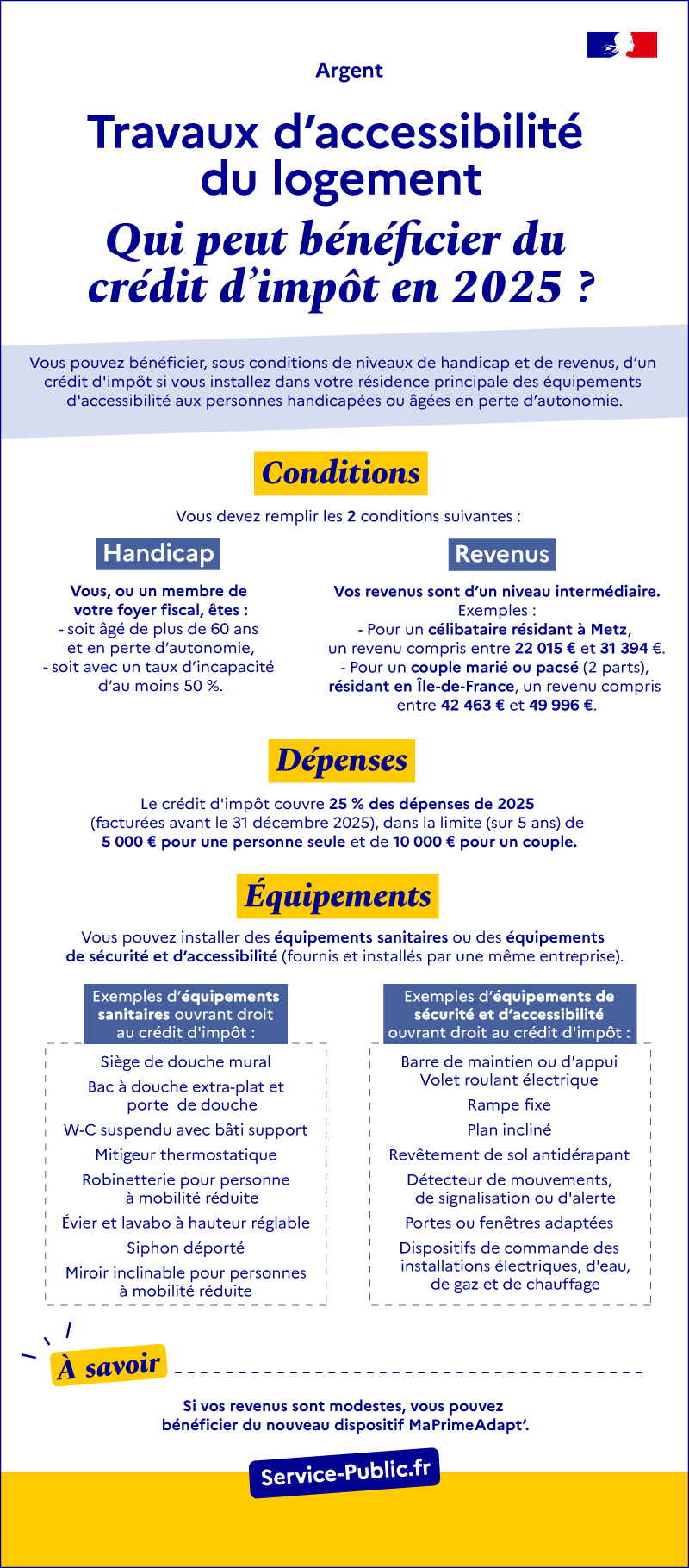
Infographie - Housing accessibility works: who can benefit from the tax credit?
Ouvrir l’image dans une nouvelle fenêtre
Title: Housing accessibility Works: who can benefit from the tax credit in 2025?
You can benefit, under conditions of disability levels and income, from a tax credit if you install in your main residence accessibility equipment for disabled or elderly people with loss of autonomy.
Conditions
You must meet the following 2 conditions:
1/ Disability
You, or a member of your tax household, are either over the age of 60 and losing autonomy, or have a disability rate of at least 50%.
2/ Income
Your income is of an intermediate level.
Examples:
For a single person residing in Metz: an income between €22,015 and €31,394.
For a married couple residing in Île-de-France: an income between €42,463 and €49,996.
Expenditure
The tax credit covers 25% of 2025 expenses (billed before December 31, 2025), up to a limit (over 5 years) of €5,000 for a single person and €10,000 for a couple.
Equipment
You can install sanitary equipment or safety and accessibility equipment (provided and installed by the same company).
Examples of sanitary equipment eligible for the tax credit:
- Wall-mounted shower seat
- Extra-flat shower tray and shower door
- Suspended toilet with support frame
- Thermostatic mixer
- Taps for people with reduced mobility
- Height-adjustable sink and sink
- Deported siphon
- Tilting mirror for people with reduced mobility
Examples of security and accessibility equipment eligible for the tax credit:
- Holding or support bar
- Electric roller shutter
- Fixed ramp
- Tilted plane
- Non-slip flooring
- Motion, signaling or alert detector
- Adapted doors or windows
- Control devices for electrical, water, gas and heating installations
To know: If your income is modest, you can benefit from the new MaPrimeAdapt' device.
Accommodation
You must be tax domiciled in France and this accommodation must be your main dwelling.
You can own, rent or occupy the property free of charge.
You must have works made in your accommodation.
If you are a tenant, you must request the prior authorization of your landlord.
If you live in a multi-family building, in which works have been made on common equipment, you benefit from the tax credit for your share of the expenses.
Warning
Works must be made by the same company.
Persons concerned
The tax credit is resource conditions.
It is reserved for people with middle incomes.
FYI
If your income is modest or very modest, you can apply to benefit from the scheme MaPrimeAdapt'. You cannot benefit from both the tax credit and the premium.
To benefit from the tax credit, you, or a member of your tax home, must be in one of the following situations:
- Aged 60 years or older and with a loss of autonomy that classifies you in one of groups 1 to 4 of the applicable national grid for personalized autonomy allocation
- With a disability rate greater than or equal to 50% (rate determined by decision of the CDAPH: titleContent).
You must also fill in income conditions.
Your household's annual income must be superior the following income:
Number of persons in the household | Revenues Île-de-France | Revenue other regions |
|---|---|---|
1 | €28,933 | €22,015 |
2 | €42,463 | €32,197 |
3 | €51,000 | €38,719 |
4 | €59,549 | €45,234 |
5 | €68,123 | €51,775 |
Per additional person | €8,568 | €6,525 |
Please note
If your 2023 income is less than or equal to these thresholds, your 2024 income is withheld.
Your annual income must also be below ceilings calculated based on the number of shares in your tax home.
Revenue caps are calculated as follows:
- €31,394 for the 1re family quotient share
- €9,301 for each of the following 2 half-parts
- €6,976 for each additional half-share from 3e.
Please note
If your 2023 income is greater than or equal to these limits, your 2024 income is withheld.
Example :
For a married or entered into a civil partnership couple (2 shares) resident in Île-de-France.
The minimum income for the tax credit is €42,463.
The income not to be exceeded in order to benefit from it is: €31,394 + (€9,301 x 2) = €49,996.
The couple's annual income must be between €42,463 and €49,996.
Example :
For one person single (1 share) resident in Metz.
The minimum income for the tax credit is €22,015.
The income not to be exceeded in order to benefit from it is €31,394.
The income of the single person must be between €22,015 and €31,394.
Date of works
Works must be made and invoiced before 31 December 2025.
The payment of a down payment, in particular when the quotation is accepted, shall not be regarded as a payment for the tax credit.
Payment is considered to have taken place at the time of final payment of the invoice.
Example :
You paid a deposit in 2024.
The invoice was issued in December 2024 and you paid the balance in January 2025.
The tax credit is available for the taxation of your 2025 income (return in 2026), for all expenses incurred.
If you are in a condominium and the works are paid through the trustee, the date taken into account is the date of payment of the amount of the works to the company that made them.
It's not the date of your appeals.
You need to have your accommodation Housing adaptation works loss of autonomy or disability.
Works for installation and replacement of equipment are concerned.
You must have made install in your accommodation one or more equipment of the following categories:
- Sanitary equipment
- Safety and accessibility equipment.
The equipment concerned is as follows:
Répondez aux questions successives et les réponses s’afficheront automatiquement
Sanitary equipment
- Height-adjustable sink and sink
- Sink and fixed washbasin usable by a person with reduced mobility
- Deported siphon
- Wall-mounted shower seat
- Full shower cabin for disabled persons
- Extra-flat shower tray and shower door
- Tiled shower tray
- Lifting pump or water suction pump for extra-flat receiver
- Raised W-C
- Suspended toilet with support frame
- W-C equipped with a washing and drying system
- Taps for people with reduced mobility
- Thermostatic mixer
- Tilting mirror for people with reduced mobility.
Safety and accessibility equipment
- Holding or support bar
- Handrail
- Motorization system for shutters, entrance and garage doors, gate
- Electric roller shutter
- Control system comprising a motion, signaling or warning detector
- Device for closing, opening or control of electrical, water, gas and heating installations
- Timed lighting coupled to a motion detector
- Adapted door pull handle or bar
- Home transfer system or ceiling bracket
- Fixed ramp
- Tilted plane
- Height-adjustable furniture
- Podotactile coating
- Contrasting and non-slip walking nose
- Non-slip flooring
- Corner Protection
- Guardrails
- Adapted door or window
- Door reversal or widening
- Sliding door
- Magnetic loop
- Vertical elevator with a platform for the transport of a disabled person and inclined lift specially designed for the movement of a disabled person.
Expenditure concerned
The expenses taken into account for the tax credit are:
- Purchase price of equipment (or materials)
- Labor costs.
Administrative or financial costs (e.g. interest) are excluded.
It's only the expenses you actually paid.
If you received financial assistance, you must deduct it.
Tax credit rate
The rate is 25% the amount of expenditure.
Expenditure ceiling
Expenditure shall be limited to one of the following amounts:
- €5,000 for a single person
- €10,000 for a married or entered into a civil partnership couple subject to common taxation.
This ceiling shall be increased by €400 per dependent (€200 per child in alternating residence).
Warning
This ceiling shall be fixed for a period of 5 consecutive years. For example, for the year 2025, it relates to expenditures between 1er January 2021 to December 31, 2025.
You will have to report in 2025 your expenses paid in 2024.
Keep your proof of expenses because the tax administration can ask you for them (company invoice, seller's certificate).
If the amount of the tax credit exceeds the amount of the tax due, the excess will be returned to you.
Expenditure paid in 2026
You cannot benefit from the tax credit for your expenses paid in 2026.
FYI
If your income is modest or very modest, you can apply to benefit from the scheme MaPrimeAdapt'.
Who can help me?
Find who can answer your questions in your region
For general information
By phone:
0809,401,401
Monday to Friday from 8:30 am to 7 pm, excluding public holidays.
Free service + price call
To contact the local service managing your file
Tax department (treasury, tax department...))
Tax credit for expenditure on aid to persons (Article 200c A)
List of equipment specially designed for the elderly or disabled (Article 18b)
Online service
Online service
FAQ
Service Public
Service Public
Service Public
Ministry of Finance
Ministry of Finance
Ministry of Finance
National Housing Agency (Anah)