

PROJECT 1 SEPT - Legalization or apostille of a public act drawn up by a French authority
Verified 01 September 2025 - Directorate for Legal and Administrative Information (Prime Minister)
You have to go abroad and you wonder whether your French documents should be legalized or not. apostilles ? We provide you with information about the procedures for authenticating a signature affixed to a public document intended to be presented to an authority of a foreigner country.
The notarial profession complete the formalities of the apostille from 1ermay 2025, and legalization since 1er september 2025.
Warning
The legalization and the apostille do not concern a French document intended for a French administration.
Step-by-step approach
To submit a French document to a foreign authority, prior authentication of the signature of the issuing authority may be required. For example, for an adoption procedure, a judicial procedure, the signing of a contract.
The legalization is the authentication procedure prior to the signature of the issuing authority.
The Apostille is a simplified procedure of legalization. It replaces legalization for the countries where it applies.
Legalization and the Apostille attest to the following information :
- Veracity of the signature of the author of the document
- Quality in which the signatory of the document acted
- If necessary, identity of seal or stamp which is mentioned on the document.
In practice, legalization and the apostille are a official stamp added to the document.
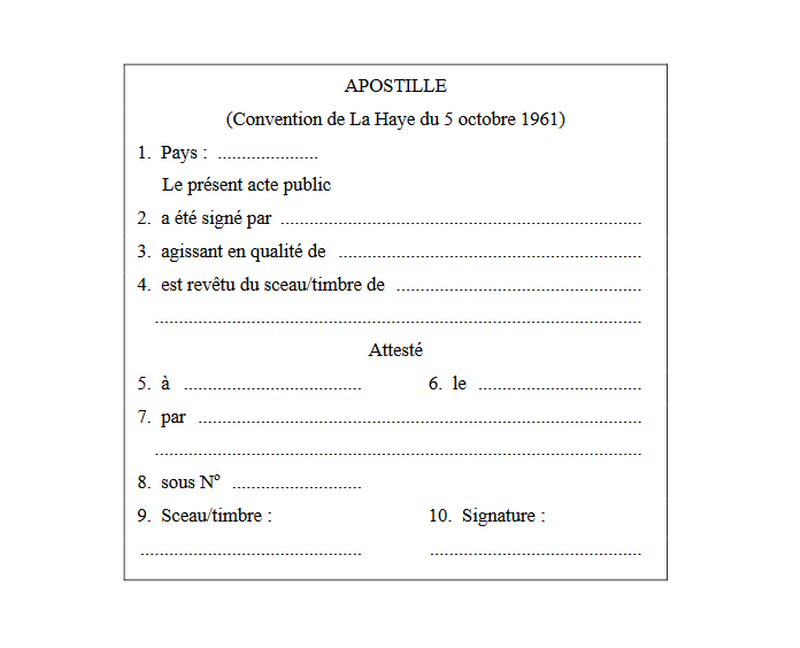
Apostille model
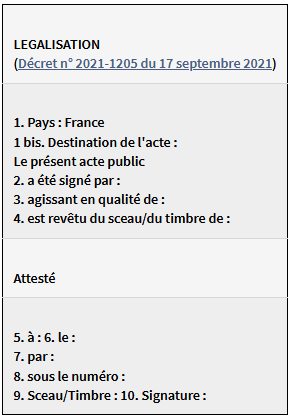
Stamp of legalization
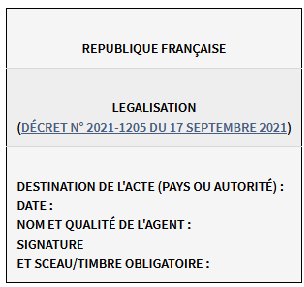
Stamp of legalization
Legalization and the Apostille concern the French public acts intended to be presented to an authority of a foreigner country.
The following documents are considered as public acts :
- Act of a judicial or administrative court. For example, a judgment.
- Act of parquet floor. For example, a judgment.
- Document drawn up by a registrar. For example, an extract from a criminal record.
- Act drawn up by a Commissioner of Justice (former bailiff and judicial auctioneer). For example, a report of findings.
- Civil status document drawn up by a civil status officer. For example, a birth certificate.
- An act drawn up by an administrative authority. For example, a tax notice, a certificate of social rights, a diploma, a school certificate.
- Notarial deed. For example, a notoriety deed, a power of attorney, a will, a donation.
- Official declaration affixed to a privately signed document. For example, a signature certification, a record of registration, a visa for a certain date.
Please note
The documents drawn up by a diplomatic or consular official and administrative documents concerning a commercial or customs operation (for example, a health certificate) are public acts. However, those acts cannot be apostilled.
One privately signed document cannot be legalized or apostilled as is.
To be legalized or apostilled, a official declaration must be affixed to the document, giving it the character of a public act.
Examples of official declarations:
- Hardware Signature Certification
- Registration notice. This may be the mention of registration of the tax office for property advertising, with which a summary note of documents relating to the transfer of ownership is deposited.
- Visa for certain date. When a public officer puts his visa on the document under private signature, the latter acquires a certain date. The visa shall give the act its character enforceable against third parties.
To be legalized or apostilled, the translation must meet the following conditions:
- The translation must be done by a sworn translator
- The signature of the sworn translator must be certified (hardware signature certification).
The translation must be submitted with the original document.
The rules vary depending on whether the document is to be presented to an authority in a the European Union or another country.
Répondez aux questions successives et les réponses s’afficheront automatiquement
You must submit a document to an authority in a European Union country
Austria, Belgium, Bulgaria, Croatia, Cyprus, Czech Republic, Denmark, Estonia, Finland, France, Germany, Greece, Hungary, Ireland, Italy, Lithuania, Latvia, Luxembourg, Malta, Netherlands, Poland, Portugal, Romania, Slovakia, Slovenia, Spain, Sweden
Some French public documents may be presented without authentication formality to an authority of a country of the European Union. These are the public documents which concern next domains : birth, being alive (life certificate), death, name, marriage, including capacity to marry and marital status, divorce, legal separation and annulment of marriage, civil pact of solidarity (Civil partnerships), dissolution annulment of Civil partnerships, filiation, adoption, domicile and/or residence, nationality, absence of criminal record.
See the e-justice site for public documents accepted by countries European without authentication formalities.
Consult the European Union's country rules to present a French public document
Different rules apply to other public documents (e.g. passport, identity document): as appropriate, they are exempt from authentication formalities or must be apostilles. To verify the applicable rule, you must consult the summary of rules by country updated by the Ministry of Foreign Affairs.
One multilingual form may be attached to certain public documents to avoid the need for translation.
You must request the multilingual form from the issuing authority.
However, the receiving authority of the country may request a translation if necessary.
In this case, the translation must be done by a sworn translator.
You must present a document to an authority in another foreigner country
To check if the document should be legalized, apostilled or is exempt from formality, you should consult the summary of rules by country updated by the Ministry of Foreign Affairs.
You can also ask the embassy or consulate in France of the destination country.
Who shall I contact
You must pay a royalty when the apostille or legalized document is issued (if the apostille or legalization is not issued, the fee is not collected). The means of payment shall be indicated to you in writing at the latest at the time of the request.
The duty-free amount of the fee varies according to the time limit requested :
Répondez aux questions successives et les réponses s’afficheront automatiquement
Fast 24-hour delay
The duty-free amount of the fee shall be:
- €20 by document if the application for issue concerns up to 3 documents
- €10 by document from 4e act.
Normal Delay
3 working days from the day on which the information necessary for processing the request is available in the national database of public signatures.
The duty-free amount of the fee shall be:
- €10 by document if the application for issue concerns up to 3 documents
- €5 by document from 4e act.
Of forwarding charge may be added if you have not attached a prepaid envelope to your application or if the amount of prepaid postage is not sufficient. The re-dispatch fee shall not exceed €5 excluding taxes.
One legal person must pay a fee for the issuing of the formalities of the apostille and legalization.
The duty-free amount of the fee varies according to the time limit requested :
Répondez aux questions successives et les réponses s’afficheront automatiquement
Fast 24-hour delay
The duty-free amount of the fee shall be:
- €40 by document if the application for issue concerns up to 3 documents
- €20 by document from 4e act.
Normal Delay
3 working days from the day on which the information necessary for processing the request is available in the national database of public signatures.
The duty-free amount of the fee shall be:
- €20 by document if the application for issue concerns up to 3 documents
- €10 by document from 4e act.
Apostille
The apostille is delivered for free in New Caledonia, French Polynesia, Wallis and Futuna Islands and French Southern and Antarctic Lands. However, you must provide a prepaid envelope for the answer.
Legalization
The price varies depending on whether you are applying in France or abroad.
Répondez aux questions successives et les réponses s’afficheront automatiquement
In France
Legalization costs €10 per document.
You can pay by check to the order of "Régie des legalizations (FDFA)" or by bank transfer.
To the foreigner
You are registered in the register of French people established outside France
Signature legalization costs €15 for a French registered in the Register of French outside France.
This price also applies to her spouse and minor children of foreign nationality.
You're in a different situation
Signature legalization costs €25.
The approach varies according to the medium of the public act to be apostilled or legalized.
Before proceeding, consult the booklet of prerequisites by type of act.
Répondez aux questions successives et les réponses s’afficheront automatiquement
Digital public act
Electronic signed digital public act
Public act bearing a digital public signature
You must submit your application online on the dedicated platform.
During the online process, you select the Apostille and Legalization Center that will process your application. In the absence of a choice, the center that is considered to be closest to your home will process your application.
TO FOLLOW PLATFORM URL:
New dedicated platform for legalization?
Or common platform for apostille and legalization formalities?
To follow new name: center of apostille and legalization?
If you cannot or do not wish to submit your application online on the dedicated platform, you must go to the Apostille and Legalization Center window of one of the 15 regional councils or interdepartmental chambers.
Who shall I contact
Welcome at the counter
By email
apostille@notaires.fr
Paper public document
You can submit your application at the counter of an apostille and legalization center or send it by mail.
Check the procedure to follow if you need to have a paper act certified by a city council, depending on whether or not the City Hall has supplied the public signature base.
At the counter of an apostille and legalization center
You can submit your application at the Apostille and Legalization Center of one of the 15 regional councils or interdepartmental chambers.
Who shall I contact
Welcome at the counter
By email
apostille@notaires.fr
By mail
You can send your request for an apostille or legalization by mail to the apostille and legalization center of one of the 15 regional councils or interdepartmental chambers.
However, you must first initiate your application online via the dedicated platform.
During the online process, you select the center that will process your request. In the absence of a choice, the center that is considered to be closest to your home will process your application.
TO FOLLOW PLATFORM URL:
New dedicated platform for legalization?
Or common platform for apostille and legalization formalities?
To follow new name: center of apostille and legalization?
Who shall I contact
Welcome at the counter
By email
apostille@notaires.fr
Apostille
The request for an apostille shall be addressed to:
- At the Court of Appeal of Nouméa, if the signatories of the public act are established in New Caledonia
- At the Papeete Court of Appeal, if the signatories of the public act are established in French Polynesia
- At the Court of First Instance of Mata Utudans, if the signatories of the public act are established in the Wallis and Futuna Islands
- To the Court of Appeal of Saint-Denis de la Réunion, if the signatories of the public act are established in the French Southern and Antarctic Lands.
The application can be made on free paper or using the form cerfa no. 15703. Attach the documents for which you are requesting an Apostille, with a stamped envelope for the response. See the form's package leaflet for instructions on how to do this.
Legalization
The legalization of a french public act intended to be presented to an authority of a foreigner country is based on the principle of double legalization.
The process is carried out in 2 steps :
- Legalization by the Bureau of Legalizations of the French Ministry of Foreign Affairs (pre-legalization)
- Legalization by a diplomatic or consular representation in France of the country in which the document is to be presented (over-legalization)
Warning
One original document issued in one copy only (e.g. diploma) or unsigned document (e.g. tax notice) cannot be legalized as such. You must submit a certified true copy of the document. Check the compliance of your document on the website of the ministry of foreign affairs.
In France
Prepare the following documents:
- Application form for international legalization, completed and signed
- Check payable to "Régie des Légalizations" (FDFA)
- Return envelope, labeled with the name and address of the applicant (in recipient and in sender) and postage at full rate (preferably registered, letter followed or Chronopost)
Send the documents to the Legalizations Office by post, registered post, Chronopost or follow-up letter.
If you have a question, you can contact the legalizations office by email.
Who shall I contact
You're informed by email the progress of your application.
If necessary, you can inquire at the center in charge of your request.
TO FOLLOW IF SAME CENTER FOR APOSTILLE AND LEGALIZATION
Who shall I contact
Welcome at the counter
By email
apostille@notaires.fr
FYI
The follow-up of the request is done by email. An email address is provided to you by the Apostille and Legalization Center if you do not have one.
A notary may not issue the legalization and apostille for an act which he has drawn up himself or which has been drawn up by another notary practicing within the same office, or for an act which contains any provision in his favor or in favor of another notary of the office.
A notary may not issue the legalization and apostille for an act to which one of his parents or allies, in a direct line, whatever the degree, or in a collateral line up to the degree of uncle or nephew included, is party, or which contains any provision in his favor.
The apostille and legalization are issued in electronic format (Apostille, eLegalization) even if you provided a paper document.
You receive an email with a link to recover on the dedicated platform a document bearing an electronic signature (Apostille, eLegalization).
TO FOLLOW IF ONLY ONE PLATFORM OR 2 PLATFORMS, APOSTILLE and LEGALIZATION
One paper printing must be provided to you if requested. In addition, if the receiving foreign authority so requires, a manual stamp and a handwritten signature may be affixed to the paper printing. You can pick it up at the counter of the center in charge of your request, or ask to receive it by mail. In this case, you will have to pay shipping costs in addition to the expected fee.
TO FOLLOW IF SAME CENTER or 2 APOSTILLE CENTERS/LEGALIZATION
Who shall I contact
Welcome at the counter
By email
apostille@notaires.fr
FYI
Where the application for the issue of the apostille or for legalization concerns a paper document, a digitized copy of the document shall be made. The scanned copy is not valid in France.
Where the receiving foreign authority so requires, the apostille and legalization formalities shall be issued in paper form on extracts or full copies of civil status documents.
On the same subject
Who can help me?
Find who can answer your questions in your region
If you have a question about a request for legalization
Legalization Office - Ministry of Foreign AffairsIf you have a question about an Apostille request
Welcome at the counter
By email
apostille@notaires.fr
- House of Justice and the Law
Ministry for Europe and Foreign Affairs
Notaries of France
France Num
Notaries of France
Notaries of France
Notaries of France
Ministry for Europe and Foreign Affairs
Ministry for Europe and Foreign Affairs
Ministry for Europe and Foreign Affairs
European Commission