

Make a donation
Verified 05 October 2026 - Public Service / (Prime Minister)
Do you want to transfer the ownership of one of your assets to another person before your death? For this, you can make a donation. You must follow certain rules for a donation to be valid. The donation must be made by notarial deed. Here is the information you need to know.
A donation is an act by which you, the donortransfer, during your lifetime and without consideration, the ownership of a property to a donee.
The donee must expressly accept the donation to make it happen.
Warning
The donation is different from manual donation and the present of use.
To make a donation, you must complete the 3 conditions following:
- Be sane, i.e. possess mental capacities allowing discernment and a sufficiently enlightened will
- Be of full age or emancipated minor
- Have the legal capacity to manage your assets.
The person in guardianship may, with the authorization of the judge or family council if it has been constituted, be assisted or, if necessary, represented by the guardian to make donations.
The person in curatorship may make a donation with the assistance of curator.
You can make a donation to the person of your choice:
- Your children or grandchildren
- Person you live with as a couple
- Other member of your family
- No stranger to your family.
You can also make a donation to certain associations.
If you are married, you can make a donation to your spouse. This is a donation to the last living.
The donation must be accepted by the donee. He can also refuse it.
A minor may receive a donation. In this case, the donation must be accepted by its legal representatives.
If the donee is deaf-mute and can write, he can accept the donation himself or go through a power of attorney. If he does not know how to write, the donation must be accepted by a curator appointed for this.
The property must be yours personally at the time of donation. It is impossible to give a future good except in a donation to the last living.
Example :
You cannot give away property that you will inherit when your parents die.
You can give real estate or furniture.
FYI
if you have donated to your child and he or she dies without progeny, you can recover the donated goods. This is called the legal right of return. You can also plan a return clause in the deed of donation: you recover the donated property if the donee dies before you, with or without descendants.
You must comply with the transmission rules imposed by law.
The reserving heirs cannot be excluded from your estate. They must receive a minimum inheritance share. So you can freely give the share that exceeds the hereditary reserve. We call this part the available quota.
If you do not comply with this rule, your heirs may question your donations at the time of the settlement of your estate. For this, they must make a action in reduction.
FYI
the reserving heir may renounce in advance to contest a donation that would deprive him of his share of inheritance. He must express this will in a inheritance pact.
However, if you have no heirs, you can donate all your belongings.
Presence of child
Number of children | Quantity available |
|---|---|
1 | 1/2 |
2 | 1/3 |
3 or more | 1/4 |
Example :
You have a heritage of €200,000 and 3 children. At the time of your succession, your children will share 3/4 of this estate either €150,000 in equal parts. Each child will therefore receive €50,000. So you can give the remaining 1/4 either €50,000 to the persons of your choice (heirs or third parties).
No children
Marital situation | Quantity available |
|---|---|
Married | 3/4 |
Unmarried | Everything |
Example :
You have a heritage of €200,000. At the time of your estate, your spouse will receive €50,000. You can give the €150,000 remaining to the persons of your choice (heirs or third parties).
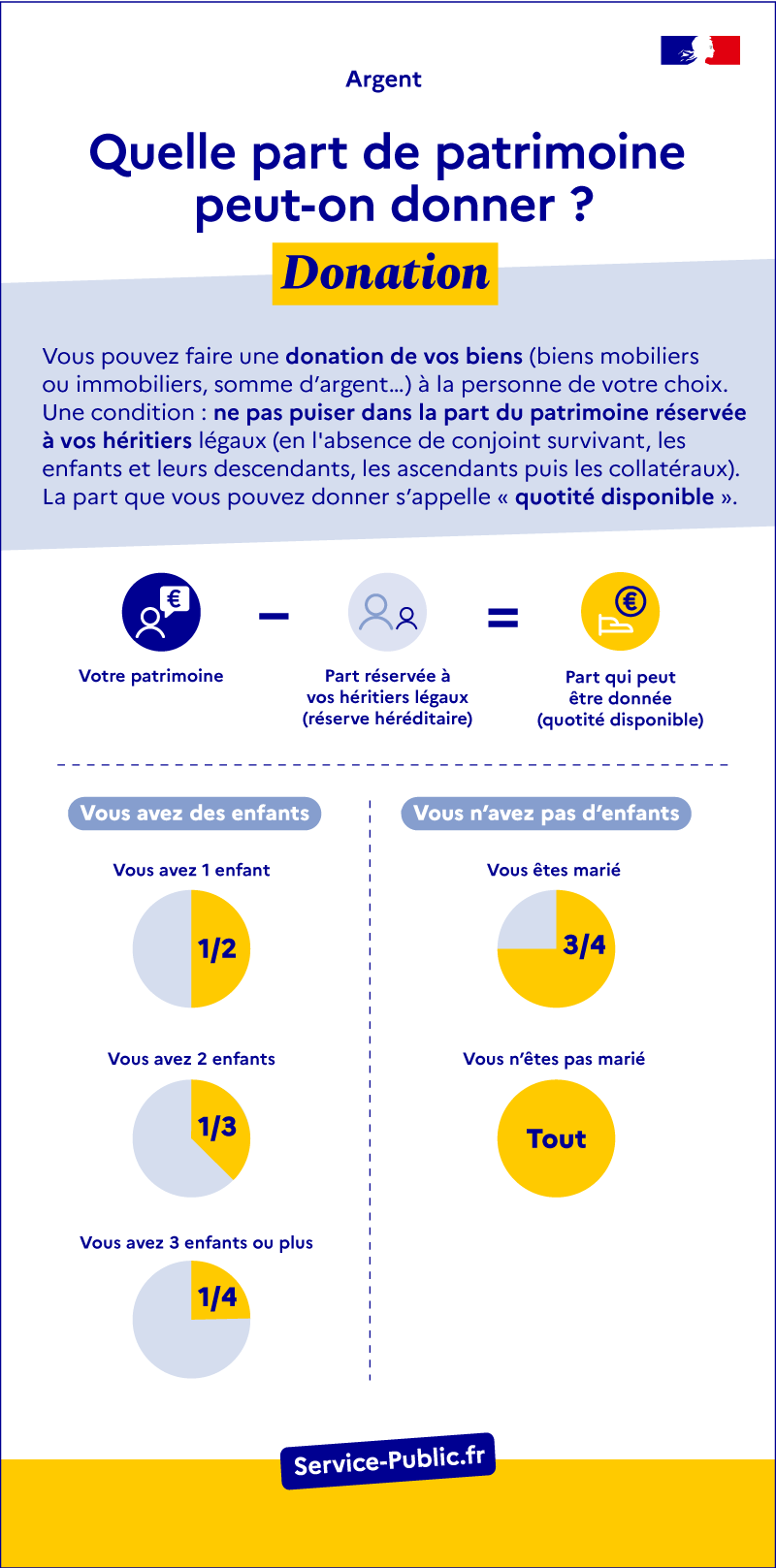
Infographie - How much heritage can we give?
Ouvrir l’image dans une nouvelle fenêtre
Donation
How much heritage can we give?
You can make a donation of your property (movable or immovable property, sum of money...) to the person of your choice.
One condition: do not draw on the part of the patrimony reserved for your legal heirs (in the absence of surviving spouse, children and their descendants, ascendants then collaterals.
The share you can give is called "available share".
Your estate - Share reserved for your legal heirs = Share that can be given (available share)
Number of children | Quantity available |
|---|---|
1 | 1/2 |
2 | 1/3 |
3 or more | 1/4 |
Marital situation | Quantity available |
|---|---|
Married | 3/4 |
Unmarried | Everything |
The donation is made by notarial act.
Who shall I contact
Taxation
You have to pay donation rights. However, you can in some cases benefit from an exemption.
If your donation includes a real estate, you also have to pay land advertising fees.
Notary fees
You have to pay notary fees.
The amount of emoluments that you have to pay to the notary is proportional to the value in full ownership donated goods.
Type of donation | Value of the property Plate slices | Cost |
|---|---|---|
Donation of intangible property, money | From €0 à €6,500 | 2,322 % HT, i.e. 2,786 % TTC of the value of the property |
From €6,500 à €17,000 | 0.958% HT or 1.149% TTC of the value of the property | |
From €17,000 à €60,000 | 0,639 % HT, i.e. 0,767 % TTC of the value of the property | |
More than €60,000 | 0.479% HT or 0.575% TTC of the value of the property | |
Other donations | From €0 à €6,500 | 4,837 % HT or 5,804 % TTC of the value of the property |
From €6,500 à €17,000 | 1,995 % HT, i.e. 2,394 % TTC of the value of the property | |
From €17,000 à €60,000 | 1,330 % HT or 1,596 % TTC of the value of the property | |
More than €60,000 | 0.998% HT or 1.1976% TTC of the value of the property |
The gift has the effect of immediately transferring ownership of the donated property to the donee.
The donation is enforceable to third parties.
In principle, a donation cannot be revoked, i.e. canceled. However, there are exceptions.
Defect in form
If the donation has not been expressly accepted or if it was not made before a notary, it can be canceled.
Cancelation can be requested by anyone interested in the donation: the donor, the donee, an heir or a creditor.
You can request the cancelation in court within 5 years from the day the donation was made.
Who shall I contact
After the course of a fact
You can request the cancelation of your donation in 3 cases.
Répondez aux questions successives et les réponses s’afficheront automatiquement
Failure to fulfill the obligations set out in the donation
A donation may require the donee carrying out certain tasks.
Example :
the donee may be obliged to lodge, feed, care for donor.
If the donee does not fulfill his obligations, you can request the cancelation of your donation by assignment in court.
Who shall I contact
You must request the cancelation within 5 years from the day on which the donee has ceased to discharge his or her expenses.
The judges determine whether the alleged facts are serious enough to authorize the cancelation of the donation.
Ingratitude
You can request cancelation for ingratitude if the donee is in any of the following cases:
- He tried to kill you
- He has committed offenses, insults or serious harm to you
- He refused to provide you with food aid, that is, financial or in kind to allow you to survive.
The facts must have been clerk after the donation.
You must request cancelation by assignment in court.
Who shall I contact
You must request the cancelation within1 year from the day you become aware of the facts.
The judges determine whether the alleged facts are serious enough to authorize the cancelation of the donation.
Birth or full adoption of a child
Except in the case of donation between spouses, you can request the cancelation of a donation made when you did not have a child. For this, you must have provided it in the deed of donation.
You must request cancelation by assignment in court within 5 years from birth or plenary adoption.
Who shall I contact
Donation to the last living
You can cancel at any time a donation to the last living, unless it was made by marriage contract.
Cancelation can be made before the notary or by will.
The donation to the last living is automatically canceled in the event of divorce, including where it was made by marriage contract.
FYI
you can cancel a donation to the last living person without your spouse being informed.
Who can help me?
Find who can answer your questions in your region
For information on the taxation of a donation
Tax department (treasury, tax department...))For general information about a donation
For more information on this subject, you can contact Allô Service Public.
Please note: the service does not have access to users' personal files and therefore cannot provide information on their progress.
- Lundi : de 08h30 à 17h30
- Mardi : de 08h30 à 12h15
- Mercredi : de 08h30 à 12h15
- Jeudi : de 08h30 à 17h30
- Vendredi : de 13h00 à 16h15
- Service free
The informants who answer you belong to the Department of Justice.
For information on how to make a donation
Notary
General provisions
Conditions for making a donation
Notarized donation (Article 931), acceptance condition (Articles 932 to 939), object of the donation (Article 943), right of return (Articles 951 and 952)
Exceptions to the rule of irrevocability of donations
Notaries' fees for a donation (article A444-67)
FAQ
Notaries of France
Notaries of France
French public finances general directorate (DGFiP)