

This page has been automatically translated. Please refer to the page in French if needed.
AI Act
Generated by artificial intelligence: how to navigate it?
Publié le 07 août 2026 - Public Service / (Prime Minister)
Since 2 August, the EU has strengthened its protection against AI: the UE AI Act now harmonizes the rules. Public Service inform you.

Artificial intelligence (AI) is advancing rapidly, making it increasingly difficult to distinguish between content generated and manipulated by AI and authentic content created by humans. Regulation [UE] 2024/1689 establishes a uniform legal framework within the EU, in particular for the development, placing on the market, putting into service and use of artificial intelligence systems.
What are the transparency obligations?
This European regulation prohibits certain practices, such as the use of artificial intelligence to deceive or manipulate you, or to exploit vulnerabilities related to age or disability situations.
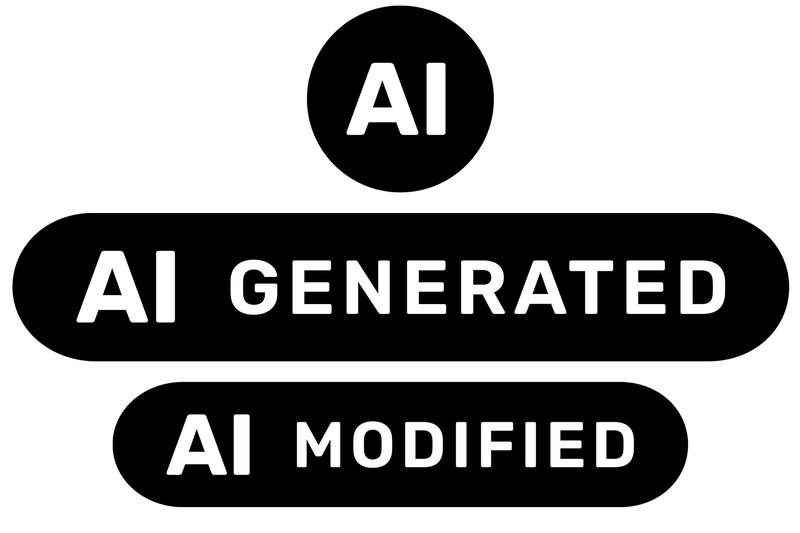
New obligations came into force on 2 August, based mainly on transparency requirements. From now on, the content generated by AI must be indicated by markings that take up all three UE icons:
- the basic icon (AI), when the AI is used to generate or modify content (text, image, audio or video);
- the « AI generated » icon, when all content is produced by an AI, without human intervention, creation or editorial control;
- the icon « partially modified by AI », when AI partially transforms pre-existing human content.
These icons will help you, when exposed to this type of content, to recognize, clearly and separately, that these elements are generated or manipulated artificially.
Infographie - Icons of AI
Ouvrir l’image dans une nouvelle fenêtre
Please note
These new transparency requirements make it easier for you to identify when you interact with or view AI-generated content, allowing you to make informed choices and better protect yourself from misinformation.
What does the AI Act specifically prohibit?
The AI Act prohibits nine practices:
- Harmful manipulation and deception based on AI.
- Harmful exploitation of vulnerabilities by AI.
- Social rating.
- Assessment or prediction of the risk of an individual criminal offense.
- Non-targeted extraction of internet data or video surveillance footage to create or expand facial recognition databases.
- Recognition of emotions in the workplace and in educational institutions.
- Biometric categorization to derive certain protected characteristics.
- Real-time remote biometric identification for law enforcement purposes in publicly accessible spaces.
- AI systems that generate non-consensual sexually explicit and intimate content or child sexual abuse material (CSAM), such as AI « nudification » apps; this ban will come into force in December 2026.
Additional AI rules will take effect from 2027: a set of specific provisions to regulate so-called high-risk AI (acting in sensitive areas such as health or safety). Their entry into force has recently been delayed to allow companies time to prepare for them.
What sanctions?
National market surveillance authorities , the European Bureau AI and the European Data Protection Supervisor are responsible for enforcing transparency rules and may impose fines:
- up to EUR 15 million, or up to 3 % of annual worldwide turnover if the offender is a company;
- up to € 750 000 for UE bodies, offices and agencies;
- taking into account proportionality for small and medium-sized companies (PME).
Please note
These provisions apply gradually, with different obligations taking effect on different dates.
Agenda
À partir du 1 sept. 2026
Rénovation énergétique
Publié le 27 août 2026
Jusqu'au 21 sept. 2026
Monnaie
Publié le 03 août 2026
À partir du 1 sept. 2026
Réforme des retraites
Publié le 17 juillet 2026